


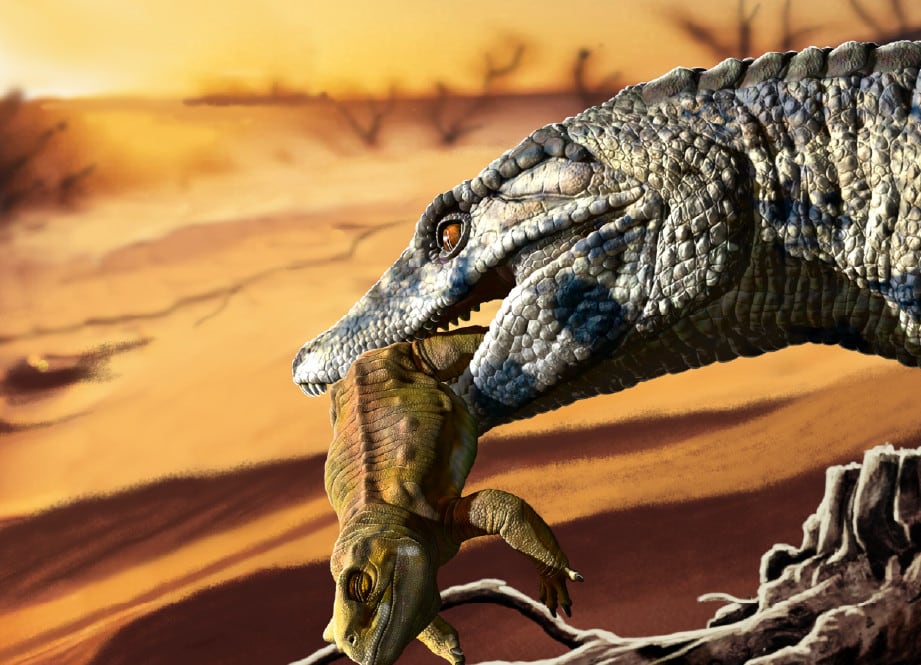
New Fossil Species of Superpredator Crocodile Identified in Patagonia
Translated from Spanish, summarized and contextualized by DistantNews.
At a glance
News
Named sources
Outcome reported
- Researchers in Patagonia, Argentina, identified a new fossil species of a superpredator crocodile from the Cretaceous period.
- The species, Antusuchus rionegrinus, was adapted to terrestrial life, unlike modern crocodiles.
- The discovery in the La Buitrera Paleontological Area sheds light on the complexity of ancient Patagonian ecosystems.
In a discovery of international significance, Argentine researchers have identified a new fossil species of crocodile that roamed the Earth during the Cretaceous period. Named Antusuchus rionegrinus, this ancient superpredator inhabited the northern region of Patagonia. The find occurred at the La Buitrera Paleontological Area in Río Negro province, a site that has become one of Argentina's most important fossil deposits over 25 years of research.
Unlike the aquatic crocodiles we know today, Antusuchus rionegrinus was fully adapted to terrestrial life. Approximately the size of a medium dog, this animal was a specialized predator within an extreme ecosystem. More than 100 million years ago, the region now comprising Río Negro and Neuquén was part of the vast, arid Kokorkom Desert, characterized by mobile sand dunes. Here, this crocodile coexisted with some of history's largest dinosaurs.
Its presence indicates that the La Buitrera ecosystem was far more complex than previously understood, adding to other known crocodiles in the area, such as the Uruguaysuchids. The research was led by María Lucila Fernández Dumont of the Fundación Azara, under the supervision of paleontologist Sebastián Apesteguía. Advanced techniques, including high-resolution computed tomography, electron microscopy, and mechanical preparation by Fundación Azara specialists, were used to analyze the fossils without damage.
The findings, published in the scientific journal Historical Biology, offer scientists a better understanding of the evolution of peirosaurids, a group of terrestrial crocodiles that were widespread across the southern continents during the age of dinosaurs. Peirosaurids developed robust skulls and snouts adapted for terrestrial hunting, becoming apex predators in Patagonian ecosystems before the dinosaurs' extinction.
DistantNews Editorial
Originally published by La Nación in Spanish. Translated, summarized, and contextualized by our editorial team with added local perspective. Read our editorial standards.
More Stories



From Our Blog

What Gets Lost (and Found) When News Is Translated

The Critical Role of Diaspora Media in Global News

What Travellers Should Know About Countries with Restricted Press

A Digital Nomad's Guide to Following Local News

How the Same Story Looks Different in Different Countries
