


🇵🇦
Panama
New ghost shark species discovered in Costa Rica
Translated from Spanish, summarized and contextualized by DistantNews.
At a glance
News
Sources not specified
Context piece
- Scientists in Costa Rica have identified a new species of ghost shark in the Pacific Ocean.
- The newly discovered fish has a shorter snout, darker coloration, and a longer dorsal fin spine than previously known species.
- Genetic analysis indicates no reproductive connection with other known ghost shark species, though similarities to Peruvian specimens warrant further study.
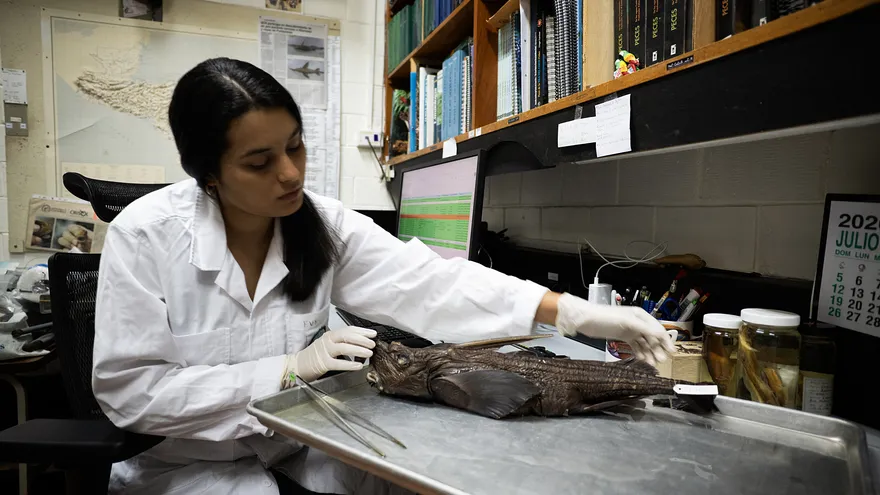
Costa Rican scientists have announced the discovery of what they believe to be a new species of ghost shark in the Pacific Ocean. This cartilaginous fish is distinguished by its shorter snout, darker coloring, and a longer dorsal fin spine compared to known species.
It is the only species (of ghost fish) known for the coast of Central America.
Until now, only three species of ghost sharks, which are related to sharks but are a distinct group of cartilaginous fish, had been recorded globally. These were found in South Africa, Taiwan, Australia, Japan, and the Atlantic Ocean. The new discovery occurred near Cabo Blanco and Isla del Caño in Costa Rica's Pacific waters, where researchers observed specimens with unique characteristics.
The new species presents a shorter snout, a darker coloration pattern, and a much longer spine in the dorsal fin.
Arturo Angulo Sibaja, a professor and researcher at the University of Costa Rica's School of Biology, stated that this is the only known ghost fish species for the Central American coast. He detailed its shorter snout, darker coloration, and significantly longer dorsal fin spine. Genetic analyses also reveal that the Costa Rican specimens have no reproductive contact with previously identified species.
the organisms from Costa Rica have no reproductive contact whatsoever with the species identified so far.
However, researchers noted similarities to specimens observed near Peru. Comparative studies will be necessary to confirm if they belong to the same species. Angulo suggested that this potential fourth species might have a broader distribution along the Pacific coasts of Central and South America. Ghost sharks, also called specter fish or rabbit fish, belong to the genus Rhinochimaera and diverged from sharks nearly 400 million years ago.
There are specimens or catches near Peru and Chile that closely resemble the (Costa Rican) species.
DistantNews Editorial
Originally published by TVN Panamá in Spanish. Translated, summarized, and contextualized by our editorial team with added local perspective. Read our editorial standards.
More Stories


From Our Blog

What Gets Lost (and Found) When News Is Translated

The Critical Role of Diaspora Media in Global News

What Travellers Should Know About Countries with Restricted Press

A Digital Nomad's Guide to Following Local News

How the Same Story Looks Different in Different Countries
