


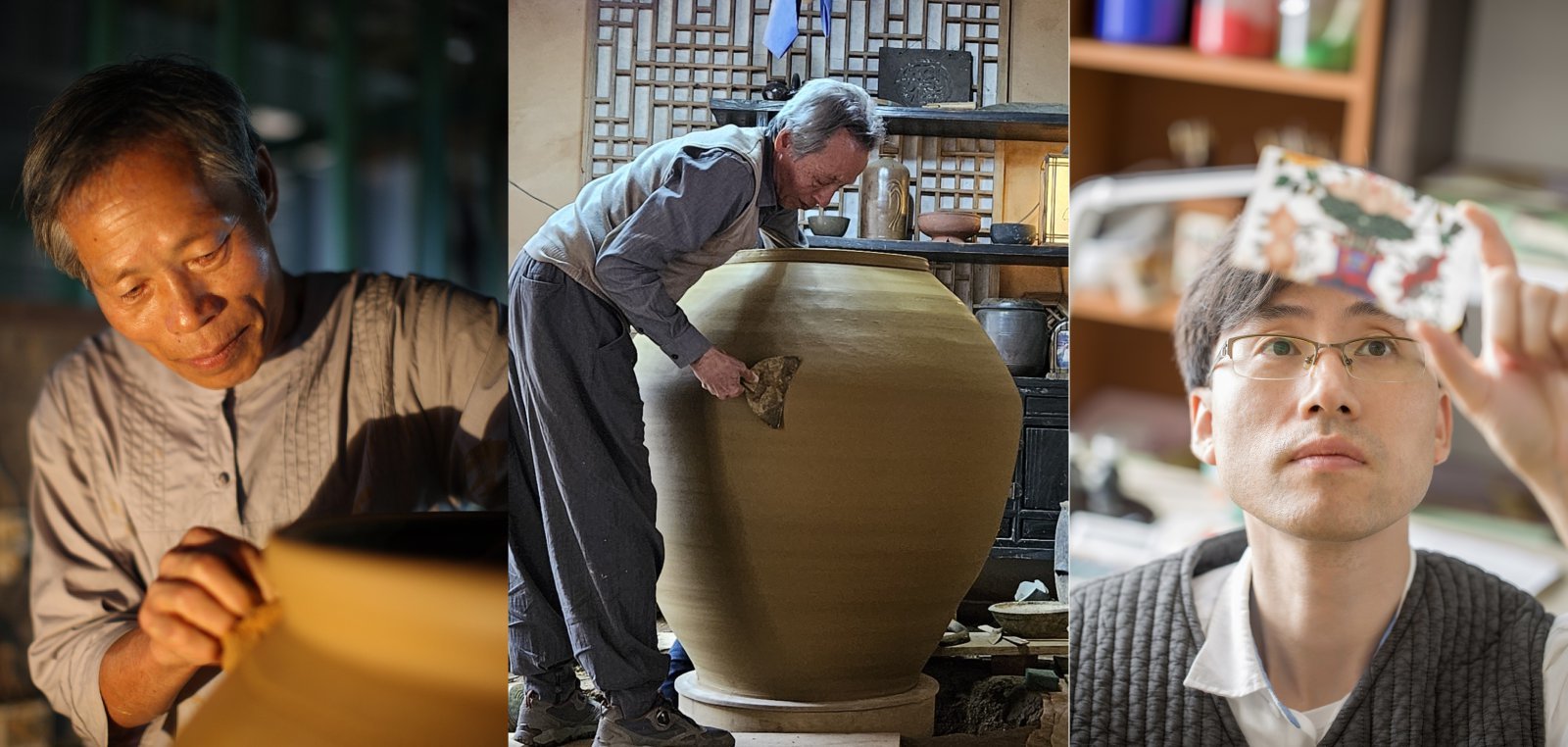
New masters recognized for traditional Korean Onggi and Hwagak crafts
Translated from Korean, summarized and contextualized by DistantNews.
At a glance
News
Official statement
New plan
- South Korea's Cultural Heritage Administration has recognized new holders of intangible cultural heritage designations.
- Bang Chun-woong and Lee Hak-soo were named new holders of the Onggi (earthenware) master designation.
- Han Ki-deok was recognized as a new holder for Hwagak (ox-horn inlay) craftsmanship.
South Korea's Cultural Heritage Administration has officially recognized new masters of traditional crafts, bolstering the preservation of the nation's intangible cultural heritage.
Bang Chun-woong, 83, and Lee Hak-soo, 71, have been designated as new holders of the Onggi master title. Onggi refers to the traditional Korean earthenware used for storing food and other items. Bang comes from a family that has been making Onggi for four generations, inheriting the tradition since his great-grandfather. Lee, son of the late Onggi master Lee Ok-dong, became a designated holder in South Jeolla Province in 2013, continuing the traditional techniques.
Additionally, Han Ki-deok, 52, has been recognized as a new holder for Hwagak craftsmanship. Hwagak involves decorating wooden objects with thin, transparent sheets made from ox horns. Han, son of the late Hwagak master Han Chun-seop from Gyeonggi Province, has inherited the traditional techniques and tools for this intricate art form.
The administration also granted honorary holder status to Kim Il-man, 85, an Onggi master, and Hwang Eul-soon, 91, a master of traditional royal court flower crafts (Gungjung Choehwa). These designations underscore the ongoing efforts to safeguard and pass down Korea's rich artistic and cultural legacy.
DistantNews Editorial
Originally published by Dong-A Ilbo in Korean. Translated, summarized, and contextualized by our editorial team with added local perspective. Read our editorial standards.
More Stories



From Our Blog

What Gets Lost (and Found) When News Is Translated

The Critical Role of Diaspora Media in Global News

What Travellers Should Know About Countries with Restricted Press

A Digital Nomad's Guide to Following Local News

How the Same Story Looks Different in Different Countries
