


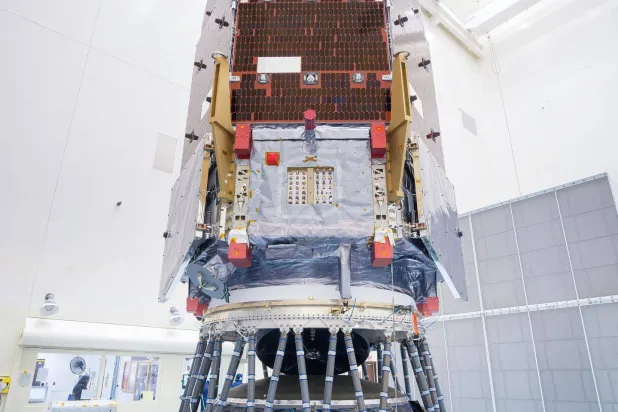
New NASA Telescope to Probe Dark Energy, Dark Matter and Exoplanets
Summarized and contextualized by DistantNews.
At a glance
News
Sources not specified
New plan
- NASA is set to launch the Nancy Grace Roman Space Telescope on Sunday, a $4 billion observatory designed to study dark energy, dark matter, and exoplanets.
- The telescope, launching nine months ahead of schedule from Florida aboard a SpaceX Falcon Heavy rocket, will expand on discoveries made by Hubble and James Webb.
- Roman's advanced capabilities, including a wide-field survey, will allow scientists to study the universe's structure, evolution, and expansion in unprecedented detail.
NASA is preparing for the Sunday launch of its next major space observatory, the Nancy Grace Roman Space Telescope. This approximately $4 billion project aims to unravel some of the universe's most profound mysteries, including the nature of dark energy and dark matter, while also testing gravity on a grand scale and searching for planets beyond our solar system.
Roman's vast reach will allow us to find the weird, the rare and the unusual.
The observatory is scheduled to lift off from NASA's Kennedy Space Center in Florida aboard a SpaceX Falcon Heavy rocket. Officials announced the launch is nine months ahead of schedule, a testament to the project's progress. Roman is positioned as a successor to iconic observatories like the Hubble Space Telescope and the James Webb Space Telescope, promising to build upon their groundbreaking discoveries.
"Roman's vast reach will allow us to find the weird, the rare and the unusual," said Julie McEnery, Roman's senior project scientist at NASA's Goddard Space Flight Center. The telescope's primary instrument boasts exceptional performance and sensitivity, enabling rapid and efficient surveys of large areas of the sky. This capability is crucial for its main survey, which is expected to take over a year to complete.
Roman's primary instrument combines exquisite performance and sensitivity with the ability to quickly and efficiently survey the large regions of the sky.
McEnery explained that the survey will encompass over two billion galaxies, providing scientists with the data to study the growth and evolution of cosmic structures. "We'll also measure how our universe has expanded over time. And these are the keys that will allow us to unlock the fundamental nature of dark matter and dark energy and the fabric of the universe itself," she stated.
The survey will contain over two billion galaxies and enable us to study how the structures in our universe, the stars, the galaxies, the clusters of galaxies, grew and evolved. We'll also measure how our universe has expanded over time. And these are the keys that will allow us to unlock the fundamental nature of dark matter and dark energy and the fabric of the universe itself.
Scientists have long sought to understand the accelerating expansion of the universe, a phenomenon attributed to dark energy. While ordinary matter constitutes about 5% of the universe's contents, dark matter is estimated at 27%, and dark energy at 68%. Cosmologist Mustapha Ishak of the University of Texas at Dallas noted the ongoing questions about dark energy's constancy over time, referencing recent hints of its evolution from other research collaborations.
The key questions are: Is dark energy simply a property of empty space that remains constant over time, or does it evolve in time?
DistantNews Editorial
Originally published by Asharq Al-Awsat. Summarized and contextualized by our editorial team with added local perspective. Read our editorial standards.
More Stories



From Our Blog

What Gets Lost (and Found) When News Is Translated

The Critical Role of Diaspora Media in Global News

What Travellers Should Know About Countries with Restricted Press

A Digital Nomad's Guide to Following Local News

How the Same Story Looks Different in Different Countries
