


Newly found 1948 U.S. secret document confirms Dokdo is Korean territory
Translated from Korean, summarized and contextualized by DistantNews.
At a glance
News
Documents & data
Context piece
- A newly discovered secret U.S. military document from 1948 confirms that "Dokdo is clearly part of Korea."
- This finding supports the consistent U.S. stance that Dokdo is Korean territory, from a 1946 directive to the San Francisco Peace Treaty negotiations.
- The document details a 1948 bombing incident where U.S. forces killed or injured Korean fishermen near Dokdo, highlighting a lack of communication regarding bombing practice areas.
A previously secret U.S. military document from 1948 has been discovered, unequivocally stating that "Dokdo is clearly part of Korea." This finding provides crucial historical evidence supporting Korea's territorial claims over the islets, also known as the Liancourt Rocks.
The document, unearthed from the U.S. National Archives and Records Administration (NARA), reinforces the long-standing U.S. position on Dokdo's sovereignty. It follows a 1946 Allied directive (SCAPIN No. 677) that explicitly excluded Ulleungdo, Dokdo, and Jeju Island from Japan's territory. The 1948 document further solidifies the U.S. stance, which remained consistent through the San Francisco Peace Treaty negotiations.
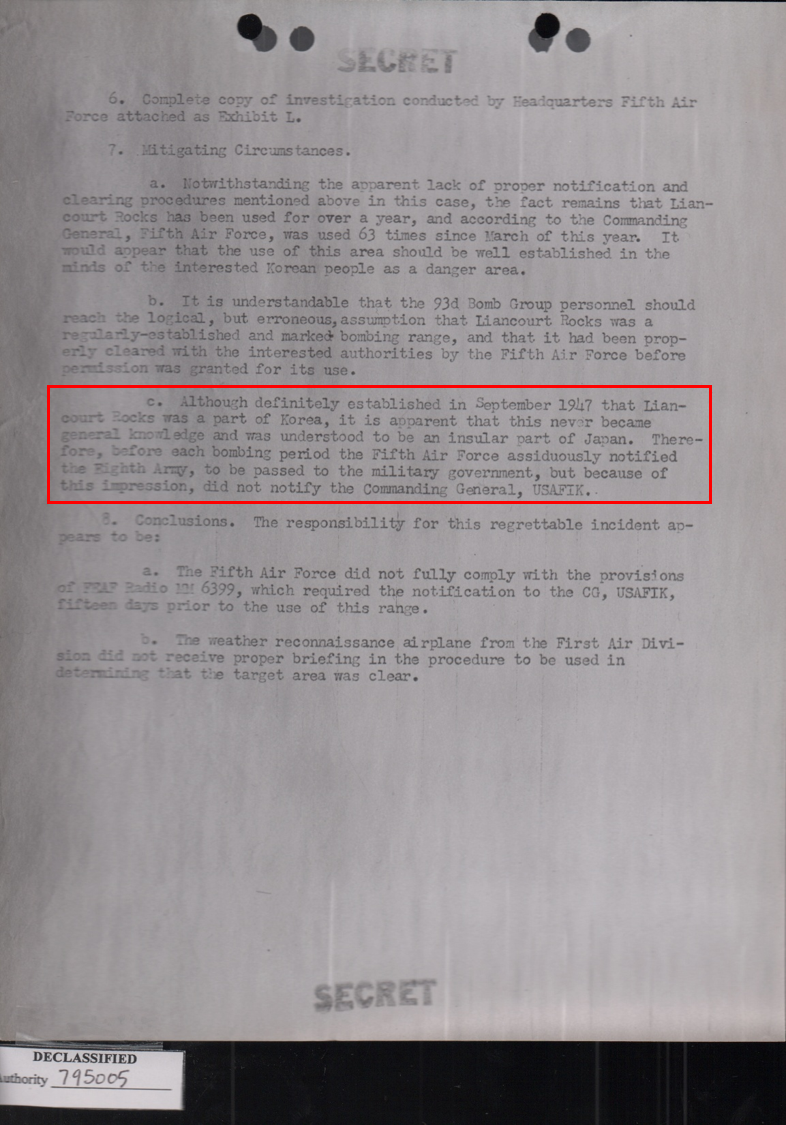
According to the Northeast Asian History Foundation, the statement "definitely established... that Liancourt Rocks was a part of Korea" appears in a "Report on Bombing of Liancourt Rocks" attached to a document drafted by the U.S. Far East Air Force (FEAF). The report details a bombing incident on June 8, 1948, when 20 B-29 bombers from the FEAF dropped bombs on Dokdo, resulting in the deaths or disappearances of 14 Korean fishermen and injuries to nine others who were fishing in the area.
definitely established …that Liancourt Rocks was a part of Korea
The report identified a critical issue: despite Dokdo being Korean territory, it was "understood to be an insular part of Japan" because this fact "never became general knowledge." This misunderstanding led to the U.S. Forces in Korea Command not being notified of the bombing practice plans, tragically impacting the Korean fishermen. The report emphasized the FEAF's responsibility to notify relevant authorities, including the Eighth Army Commander and the Commander of U.S. Forces in Korea, 15 days prior to using any bombing practice range, underscoring the need for communication when operating over Korean territory.
This discovery is significant as it provides primary source material from a third party, the United States, directly confirming Korean sovereignty over Dokdo during the critical post-liberation period. The documents also include Korean official records from 1946-1948, such as statements from local administrators and residents, detailing Korea's assertion of sovereignty and its practical use of the islets as fishing grounds. These materials help fill a gap in historical records concerning Korea's territorial claims immediately following its liberation.
this never became general knowledge and was understood to be an insular part of Japan
DistantNews Editorial
Originally published by Dong-A Ilbo in Korean. Translated, summarized, and contextualized by our editorial team with added local perspective. Read our editorial standards.
More Stories


From Our Blog

What Gets Lost (and Found) When News Is Translated

The Critical Role of Diaspora Media in Global News

What Travellers Should Know About Countries with Restricted Press

A Digital Nomad's Guide to Following Local News

How the Same Story Looks Different in Different Countries
