


Nobel Laureates and Global Scholars Warn AI Could Spark Faster, Larger Economic Shift Than Industrial Revolution
Translated from Korean, summarized and contextualized by DistantNews.
At a glance
News
Named sources
New plan
- Over 200 global scholars, including 16 Nobel laureates in economics, have issued a joint statement on artificial intelligence.
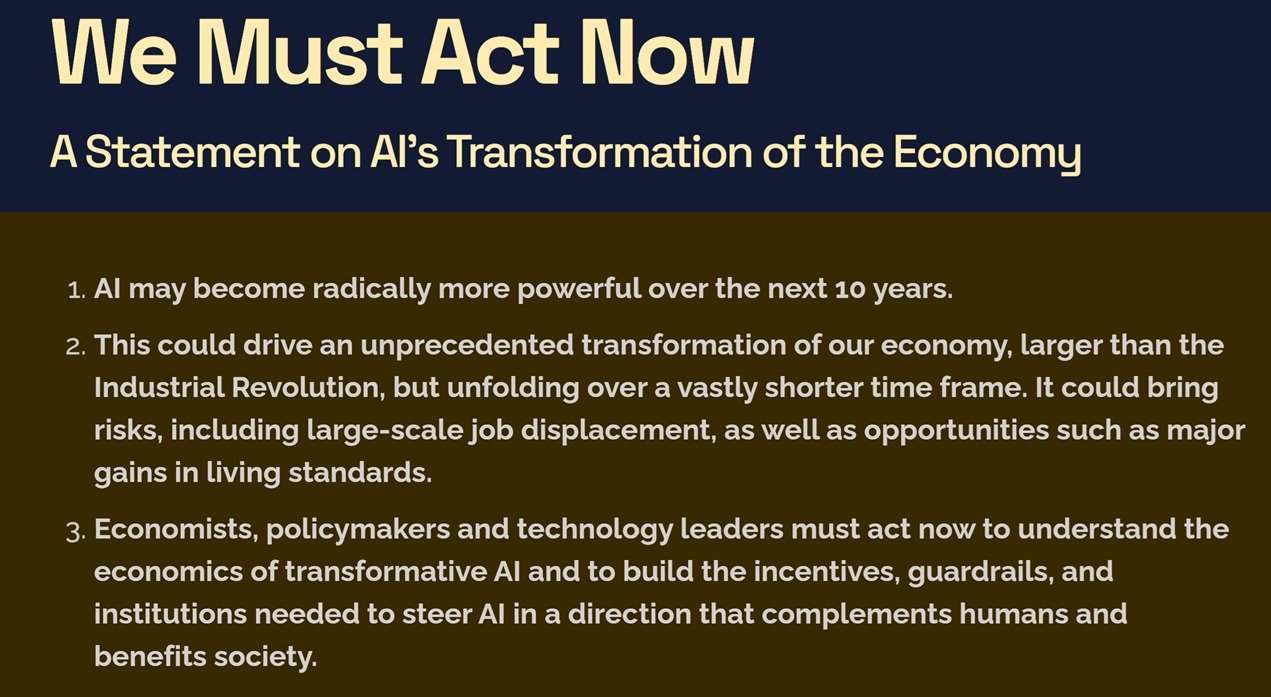
- They warn that AI could trigger an unprecedented economic transformation in a much shorter period than the industrial revolution.
- The statement urges economists, policymakers, and tech leaders to act now to ensure AI benefits humanity.
A significant warning about the transformative power of artificial intelligence has been issued by a collective of over 200 leading global scholars, including 16 Nobel laureates in economics. Their joint statement asserts that AI is poised to drive an economic shift of unprecedented scale, occurring at a pace far exceeding that of the industrial revolution.
AI can bring about an unprecedented economic transformation, unfolding over a much shorter period than the industrial revolution.
The scholars highlight that while the changes brought by steam power and electricity unfolded over decades, the disruptions caused by AI could materialize within just a few years. This accelerated timeline presents both immense opportunities and significant risks, demanding immediate attention from various sectors.
Central to their message is a call to action for economists, policymakers, and technology leaders. The statement emphasizes the urgent need to develop incentives, safeguards, and institutional frameworks. These measures are crucial to ensure that AI technologies are developed and deployed in ways that complement human capabilities and ultimately serve the broader interests of society.
Economists, policymakers, and technology leaders must act now to create incentives, safeguards, and institutions to ensure AI complements humans and benefits society.
The initiative was spearheaded by four economists, including Stanford University's Erik Brynjolfsson, and supported by the university's Digital Economy Research Institute. The statement also garnered support from scientists and executives at prominent AI companies such as Anthropic, Google, and OpenAI, underscoring the broad consensus on AI's profound potential impact.
AI could develop into a much more powerful technology within the next 10 years.
DistantNews Editorial
Originally published by Dong-A Ilbo in Korean. Translated, summarized, and contextualized by our editorial team with added local perspective. Read our editorial standards.
More Stories



From Our Blog

What Gets Lost (and Found) When News Is Translated

The Critical Role of Diaspora Media in Global News

What Travellers Should Know About Countries with Restricted Press

A Digital Nomad's Guide to Following Local News

How the Same Story Looks Different in Different Countries
