


North Korea Reveals New Nuclear Facility, Raising Concerns Over Strengthened Capabilities
Translated from Korean, summarized and contextualized by DistantNews.
At a glance
Analysis
From a news agency
Ongoing story
- North Korea announced that leader Kim Jong Un visited a newly operational nuclear material production facility.
- The state media reported that the country's capacity to produce weapons-grade nuclear material has doubled since January 2021.
- This development raises concerns about North Korea's strengthening nuclear capabilities and puts pressure on South Korea and the U.S. to reassess their North Korea policy.
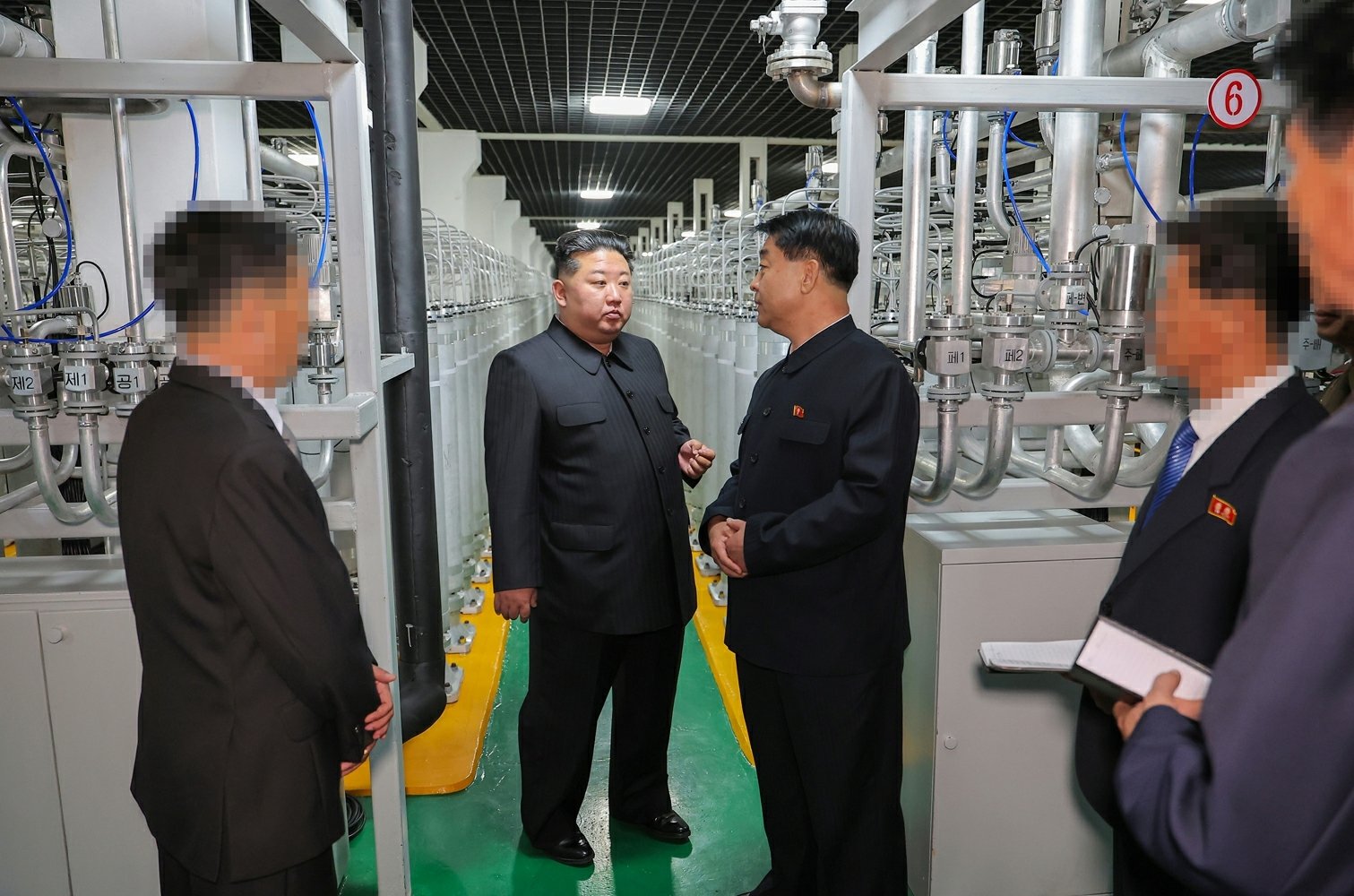
North Korea announced on April 4th that leader Kim Jong Un conducted an on-site inspection of a newly operational nuclear material production facility. While North Korea has previously revealed facilities related to highly enriched uranium (HEU) production, this marks the first time it has announced a visit to a new facility that was not previously operational. This move is interpreted as a strategic warning to the United States and the international community, signaling an intent to exponentially strengthen its nuclear arsenal if dialogue is not pursued.
The state-run Korean Central News Agency (KCNA) reported that Kim Jong Un stated the country's capacity to produce weapons-grade nuclear materials has more than doubled since the 8th Party Congress in January 2021. He also mentioned that a strategic decision was made at the 9th Party Congress in February to further expand nuclear material production capacity and increase the number of nuclear weapons.
North Korea first disclosed its uranium enrichment facility in Yongbyon in November 2010. Since then, Kim Jong Un has been shown inspecting weapons-grade nuclear material production bases on two occasions: September 2024, just before the U.S. presidential election, and January 2025, shortly after the inauguration of a potential second Trump administration. While the Yongbyon facility is confirmed, there have been suspicions of similar facilities in Kangson and Guseong. It remains unclear whether the newly revealed facility is one of these existing sites or a "fourth facility."
Our country's nuclear weapons capability will be exponentially strengthened.
This public disclosure confirms that North Korea's nuclear capabilities are steadily advancing, placing pressure on both the South Korean and U.S. governments to fundamentally reassess their policies toward Pyongyang. Although President Trump has referred to North Korea as a "nuclear power," his administration's commitment to denuclearization efforts remains uncertain amid the ongoing U.S.-Iran conflict. However, voices within the U.S. are increasingly advocating for a shift from denuclearization to arms control negotiations as a long-term goal.
The South Korean government under President Lee Jae-myung has previously proposed a phased approach to denuclearization, moving from "halt" to "reduction" and then "dismantlement," acknowledging the difficulty of immediate denuclearization. Close communication with the United States is crucial to developing realistic solutions. The article emphasizes the need for a strategic decision on whether to acknowledge North Korea's nuclear status as "transitional" and engage in dialogue, or to adhere to the principle of denuclearization and observe the growth of North Korea's nuclear capabilities.
The capacity for weapons-grade nuclear material production has more than doubled since January 2021, and a strategic decision was made to further expand nuclear material production capacity and increase the number of nuclear weapons.
DistantNews Editorial
Originally published by Hankyoreh in Korean. Translated, summarized, and contextualized by our editorial team with added local perspective. Read our editorial standards.
More Stories

From Our Blog

What Gets Lost (and Found) When News Is Translated

The Critical Role of Diaspora Media in Global News

What Travellers Should Know About Countries with Restricted Press

A Digital Nomad's Guide to Following Local News

How the Same Story Looks Different in Different Countries
