


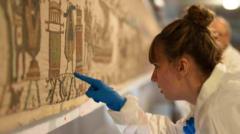
'Nothing left to chance' for Bayeux Tapestry's journey to London
Summarized and contextualized by DistantNews.
At a glance
News
Named sources
New plan
- The 950-year-old Bayeux Tapestry is set to travel from France to London for a nine-month exhibition at the British Museum.
- French officials assure the tapestry will be transported with extreme care, using a specially designed double-crate system with shock absorbers.
- Despite assurances, some French art world figures remain skeptical about the risks involved in moving such a fragile and important artifact.
The historic Bayeux Tapestry is embarking on an unprecedented journey to London, where it will be displayed at the British Museum for nine months. French officials have declared that the 950-year-old artwork will be as safe as "a baby" during its transit.
I am extremely serene. Nothing has been left to chance.
This marks only the third time in its history that the tapestry will leave its home in Bayeux. The move has sparked serious reservations among many in France's art community, who argue that the tapestry is too fragile and significant to risk relocation. However, after conducting two trial runs with facsimiles, the French Ministry of Culture expressed confidence that all technical challenges have been overcome.
The idea is that the vertical shocks which will occur are transformed into horizontal shocks, causing the inner crate to rock to and fro like a baby in a cradle.
To ensure its protection, the 70-meter-long tapestry will be housed in a sophisticated double-crate system. An inner aluminum crate, designed to regulate temperature and humidity, will be placed inside an outer shell. This ensemble will be mounted on a lorry equipped with 12 metal springs acting as shock absorbers, transforming vertical impacts into gentler horizontal movements. Experts stated that trial runs demonstrated shocks being reduced by 96%, bringing them to a level comparable to what artworks experience simply by being on display.
Don't forget an artwork receives vibrations merely from the footsteps of all the visitors to a museum.
Despite these elaborate precautions, some specialists, like arts writer Didier Rykner, remain unconvinced. Rykner expressed skepticism about the technical reports, viewing them as justifications for a pre-determined political decision. He raised concerns about potential issues during transit, such as the lorry becoming stuck in the Channel tunnel, questioning the reliability of the assurances provided.
What happens if there is a problem in the tunnel and the lorry gets stuck there? These technical reports they have produced are meaningless – they're just there to justify the political decision that's already been taken.
DistantNews Editorial
Originally published by BBC News. Summarized and contextualized by our editorial team with added local perspective. Read our editorial standards.
More Stories


From Our Blog

What Gets Lost (and Found) When News Is Translated

The Critical Role of Diaspora Media in Global News

What Travellers Should Know About Countries with Restricted Press

A Digital Nomad's Guide to Following Local News

How the Same Story Looks Different in Different Countries
