


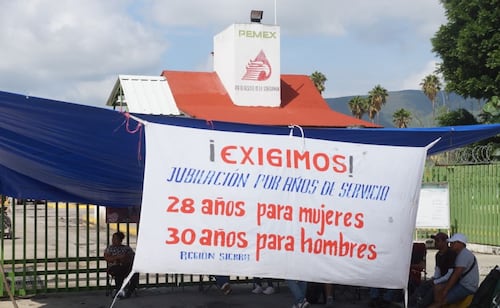
Oaxaca teachers occupy Pemex plant for over 24 hours, plan airport and highway protests
Translated from Spanish, summarized and contextualized by DistantNews.
At a glance
News
Named sources
Ongoing story
- Teachers from Oaxaca's Section 22 of the SNTE have occupied a Pemex storage plant for over 24 hours, blocking access.
- The teachers plan further protests at the Oaxaca international airport and toll booths.
- Their demands include the repeal of the 2007 ISSSTE Law and the educational reform, seeking direct negotiations with President Claudia Sheinbaum.
Teachers affiliated with Section 22 of the SNTE in Oaxaca have maintained their occupation of a Pemex hydrocarbon storage plant for more than 24 hours, continuing to block access to the facility. The indefinite occupation began yesterday as part of a broader action plan by the National Coordinating Committee of Education Workers (CNTE) to demand government action on their grievances.
The Pemex plant, located in San Pablo Huitzo in the Central Valleys region of Oaxaca, is a critical distribution point for gasoline stations. The teachers' union has announced further actions, including renewed protests at the Oaxaca international airport and the provision of free passage at toll booths on major federal highways connecting the state.
CNTE leaders, in a national representative assembly, deemed the federal government's responses to their core demands insufficient. Key among these demands are the repeal of the 2007 ISSSTE Law and the educational reform. The teachers are also insisting on direct negotiations with President Claudia Sheinbaum Pardo, citing her previous promises regarding the abrogation of the ISSSTE Law.
The ongoing protests highlight the persistent tensions between the education workers and the federal government over labor rights and educational policies. The occupation of the Pemex facility disrupts fuel distribution, underscoring the union's willingness to escalate actions to pressure authorities for a resolution.
DistantNews Editorial
Originally published by El Universal in Spanish. Translated, summarized, and contextualized by our editorial team with added local perspective. Read our editorial standards.
More Stories


From Our Blog

What Press Freedom Means for the News You Read

What Gets Lost (and Found) When News Is Translated

The Critical Role of Diaspora Media in Global News

What Travellers Should Know About Countries with Restricted Press

A Digital Nomad's Guide to Following Local News
