


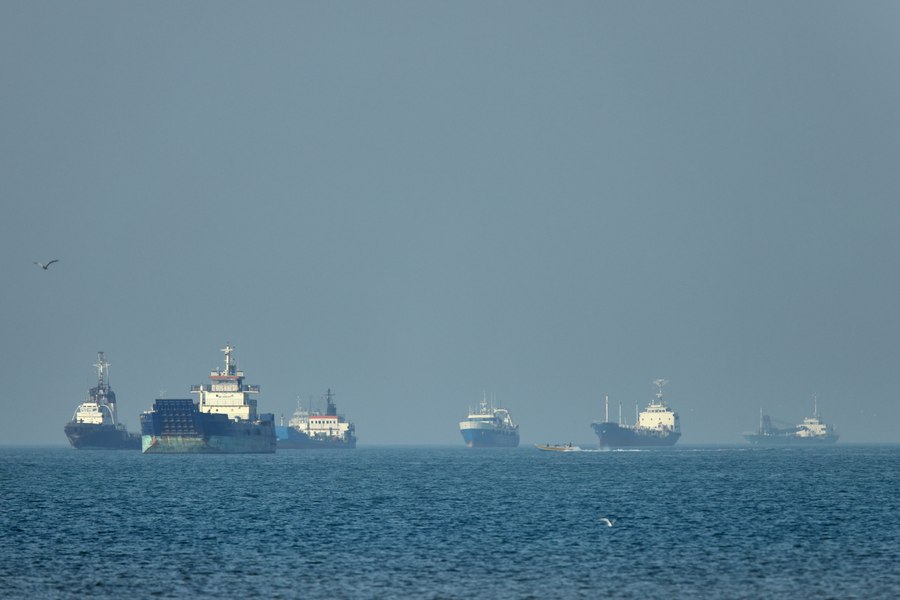
Oil Prices Stable Despite Hormuz Blockade, Clandestine Flows Suspected
Translated from Romanian, summarized and contextualized by DistantNews.
At a glance
News
Named sources
Context piece
- Global oil markets remain surprisingly calm despite a severe supply shock caused by a three-month blockage in the Strait of Hormuz.
- One theory suggests a significant volume of crude oil is bypassing the blockade through
Global oil markets have defied expectations, remaining remarkably stable despite a severe supply shock stemming from a three-month blockage in the Strait of Hormuz. This scenario, once considered a nightmare, has not triggered the predicted price surge.
In spite of the ongoing naval blockade and the drastic reduction in commercial traffic, surprising volumes of crude oil and petroleum products appear to continue to transit the strait.
Analysts suggest that a substantial amount of crude oil is "slipping" through the blockade, helping the global energy system absorb the shock. Tankers carrying these "clandestine flows" may be evading detection by turning off their transponders, experts told CNN. JPMorgan estimated these clandestine flows at approximately 2.1 million barrels per day in late May, a small but notable portion of the 15.6 million barrels per day that typically pass through the strait.
We assume that traffic through Hormuz has been between 0% and 10% of pre-war flows, but with this leakage it could be a bit higher.
"Despite the ongoing naval blockade and the drastic reduction in commercial traffic, surprising volumes of crude oil and petroleum products appear to continue to transit the strait," wrote Natasha Kaneva, head of global commodities strategy at JPMorgan. Bob McNally, founder and president of Rapidan Energy Group, agreed that clandestine flows might have delayed or somewhat mitigated the crisis. He noted that while these flows are "not nearly enough to avoid the large reductions that would support price increases, it does ease the pressure."
It is not nearly enough to avoid the large reductions that would support price increases, but it does ease the pressure.
Economist Jan Stuart of Piper Sandler estimates that around 2.9 million barrels per day of crude oil exited the Strait of Hormuz in May. This includes about 2.1 million barrels on ships that appear to have paid fees to Iranian entities, and roughly 900,000 barrels from "ghost" passages where ships turned off transponders. "The ghosts, or clandestine flows, are helping," Stuart told CNN. "The crisis has been much better contained than I would have thought possible." Brent crude futures, the international benchmark, fell to $93 a barrel on Friday, still above pre-war levels of around $70.
The ghosts, or clandestine flows, are helping.
DistantNews Editorial
Originally published by Adevărul in Romanian. Translated, summarized, and contextualized by our editorial team with added local perspective. Read our editorial standards.
More Stories



From Our Blog

What Gets Lost (and Found) When News Is Translated

The Critical Role of Diaspora Media in Global News

What Travellers Should Know About Countries with Restricted Press

A Digital Nomad's Guide to Following Local News

How the Same Story Looks Different in Different Countries
