


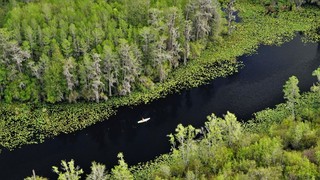
Okefenokee, prehistoric freshwater sanctuary in U.S., aspires to be a UNESCO treasure
Translated from Spanish, summarized and contextualized by DistantNews.
At a glance
News
Named sources
Context piece
- The Okefenokee National Wildlife Refuge in the U.S. is a candidate for UNESCO World Heritage status.
- Spanning over 162,000 hectares in Georgia and Florida, it is one of seven natural sites nominated this year.
- Its ancient peat deposits and diverse ecosystems are key criteria for its nomination.
The Okefenokee National Wildlife Refuge, a vast freshwater sanctuary in the southern United States, is vying for a spot on the UNESCO World Heritage List. This ancient wetland, largely preserving its prehistoric conditions, is among seven natural sites nominated for inscription this year, and the sole U.S. candidate.
The refuge, covering more than 162,000 hectares across Georgia and Florida, will have its nomination evaluated starting Monday at the 48th UNESCO World Heritage Committee meeting in Busan, South Korea. The committee will review 30 new sites for potential inscription during its ten-day session.
Okefenokee is recognized as one of the world's largest freshwater ecosystems. It holds extensive peat deposits formed over approximately 5,000 years. These accumulated organic materials act as a natural archive, offering insights into prehistoric climate and vegetation. The area also supports 21 vegetation types and a rich array of fauna, including over 1,000 moth species, according to the U.S. candidacy documentation submitted in 2008.
The primary justifications for Okefenokee's World Heritage status are its peat beds, which "represent significant stages in the history of the Earth," and its remarkable biodiversity. From above, the swamp appears as an intricate water labyrinth, feeding two rivers that flow in opposite directions, one to the Atlantic Ocean and the other to the Gulf of Mexico. Its potential inscription would place it alongside the Everglades, another significant U.S. wetland ecosystem designated a World Heritage site in 1979. Unlike the Everglades, Okefenokee has experienced less hydrological impact from human activity, with conservation efforts focused on restoring natural processes.
DistantNews Editorial
Originally published by El Deber in Spanish. Translated, summarized, and contextualized by our editorial team with added local perspective. Read our editorial standards.
More Stories


From Our Blog

What Gets Lost (and Found) When News Is Translated

The Critical Role of Diaspora Media in Global News

What Travellers Should Know About Countries with Restricted Press

A Digital Nomad's Guide to Following Local News

How the Same Story Looks Different in Different Countries
