


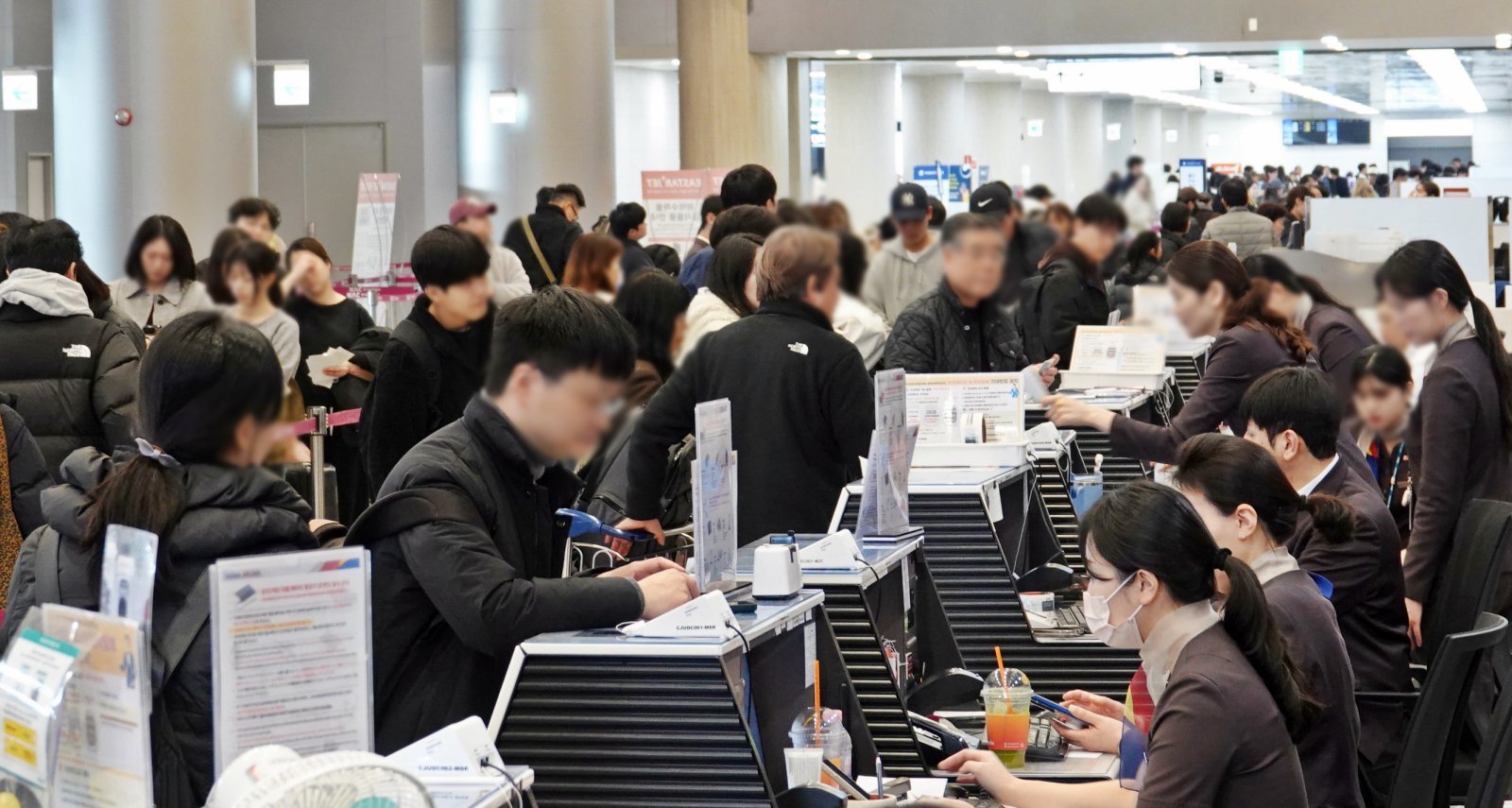
Over 70,000 Domestic Flights Delayed Last Year; Jin Air Had the Most
Translated from Korean, summarized and contextualized by DistantNews.
At a glance
News
Named sources
Context piece
- Over 70,000 domestic flights were delayed across 13 South Korean airports last year, a 12% decrease from the previous year.
- Jin Air recorded the highest number of delays at 14,889, followed by Korean Air and Jeju Air.
- Jeju Airport experienced the most delays (31,196), followed by Gimpo Airport (21,736).
Last year, South Korea recorded 71,709 domestic flight delays across 13 airports, excluding Muan Airport. This figure represents a decrease of approximately 12% compared to the 81,371 delays reported in 2024.
Jin Air experienced the highest number of delays among airlines, with 14,889 instances. Korean Air followed with 13,244 delays, and Jeju Air had 11,444. Other airlines with significant delays included Asiana Airlines (9,488) and T'way Air (8,270).
Jeju Airport registered the most delays, totaling 31,196, while Gimpo Airport recorded 21,736. Gimhae Airport followed with 7,820 delays, and Cheongju Airport had 3,510.
To reduce inconvenience for citizens using aircraft during the summer vacation season, the government and the aviation industry must prepare effective measures to prevent aircraft delays.
Looking at the past five years, domestic flight delays saw an increase from 26,288 in 2021 to 31,628 in 2022. In 2023, the number surged to 88,342 after the government changed the calculation standard from runway take-off/landing times to gate entry/exit times. The figures have since decreased to 81,371 in 2024 and 71,709 in 2025. As of the first half of this year, 28,628 delays have been reported.
Kim Jong-yang, a member of the National Assembly's Land, Infrastructure and Transport Committee, urged the government and airlines to develop effective measures to prevent flight delays, especially during peak travel seasons like summer vacation. He also called for optimizing slot operations at busy airports like Jeju, Gimpo, and Gimhae to alleviate congestion and urged for urgent infrastructure expansion at provincial airports experiencing rapid growth in passenger numbers.
We need to resolve congestion by optimizing time-based slot operations at busy airports like Jeju, Gimpo, and Gimhae, and urgently expand the infrastructure of provincial hub airports where passenger numbers are rapidly increasing.
DistantNews Editorial
Originally published by Dong-A Ilbo in Korean. Translated, summarized, and contextualized by our editorial team with added local perspective. Read our editorial standards.
More Stories


From Our Blog

What Gets Lost (and Found) When News Is Translated

The Critical Role of Diaspora Media in Global News

What Travellers Should Know About Countries with Restricted Press

A Digital Nomad's Guide to Following Local News

How the Same Story Looks Different in Different Countries
