

Pakistan: Defence minister tells interior minister to start governance reset in his own ministry
Translated from English, summarized and contextualized by DistantNews.
At a glance
News
Named sources
Context piece
- Pakistan's Defence Minister Khawaja Asif responded to Interior Minister Mohsin Naqvi's call for a governance reset, suggesting Naqvi start with his own ministry.
- Naqvi had stated the country's governance system had collapsed and called for new administrative units and leadership.
- The military's spokesperson also urged political parties to consider an administrative overhaul for national security and stability.
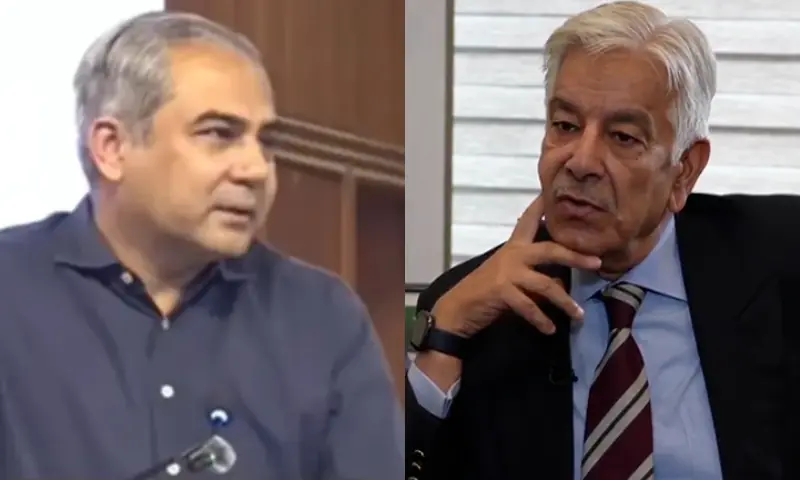
Pakistan's Defence Minister Khawaja Asif has publicly advised Interior Minister Mohsin Naqvi to begin his proposed governance overhaul within his own ministry, questioning the impact of Naqvi's broad statements made at a business summit.
Mohsin Naqvi’s sahib expressed his views on the dire state of the system. I more or less personally agree with these views.
Naqvi had previously declared the country's governance system "collapsed" and advocated for new administrative units, improved service delivery, and new leadership. He emphasized that the youth desire justice, merit, and employment over handouts. These remarks followed a similar call from the military's spokesperson, Director General of Inter-Services Public Relations Lt Gen Ahmed Sharif Chaudhry, who stressed that effective governance is a prerequisite for national security and stability.
Asif, while largely agreeing with Naqvi's assessment of the system's stagnation due to "factional and personal interests," stressed the importance of addressing these issues through constitutional forums like Parliament or the cabinet. He noted that Naqvi, as a member of the cabinet, rarely attends these sessions. Asif suggested that making significant statements to a select audience of businessmen, rather than engaging in parliamentary or cabinet discussions, diminishes their weight.
As a political worker, I too strongly felt the process of the system’s evolution had been held captive to factional and personal interests for decades, and it needs to be freed.
"If the system has to be strengthened and a fundamental change has to be brought about, its forum is Parliament, of which Naqvi sahib is a member. Or this matter could be discussed in the cabinet," Asif stated in a post on X, referencing Naqvi's remarks and the DG ISPR's comments. He added that such actions would strengthen institutions and ensure change occurs through a constitutional process.
If the system has to be strengthened and a fundamental change has to be brought about, its forum is Parliament, of which Naqvi sahib is a member. Or this matter could be discussed in the cabinet.
Asif also pointed out that Naqvi has held a "very powerful post" for the past three years. He implied that Naqvi could have initiated discussions or made progress on systemic change during this period if he had desired. The Defence Minister's comments highlight a tension between calls for radical reform and the established parliamentary and governmental processes within Pakistan.
In my opinion, [treating] these institutions as irrelevant and making such a big statement to a captive audience after inviting the country’s eminent and respected businessmen doesn’t carry the same weight that speaking at the relevant constitutional forums would have earned.
DistantNews Editorial
Originally published by Dawn in English. Translated, summarized, and contextualized by our editorial team with added local perspective. Read our editorial standards.
More Stories
From Our Blog

What Gets Lost (and Found) When News Is Translated

The Critical Role of Diaspora Media in Global News

What Travellers Should Know About Countries with Restricted Press

A Digital Nomad's Guide to Following Local News

How the Same Story Looks Different in Different Countries
