


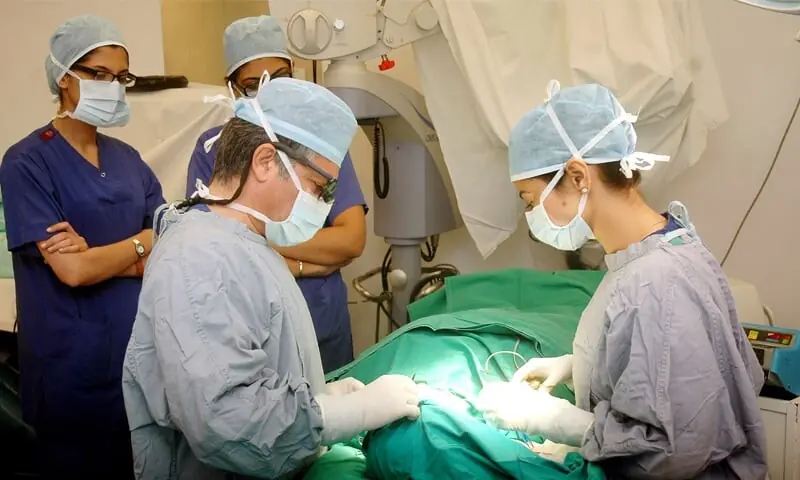
Pakistan Kidney and Liver Institute proposes National SWAP Liver Transplant Programme
Summarized and contextualized by DistantNews.
At a glance
News
Named sources
Outcome reported
- Pakistan Kidney and Liver Institute proposed a National SWAP Liver Transplant Programme to aid patients with incompatible donors.
- The proposal follows the institute's success in performing the world's first 10-way Living Donor Liver Transplant (LDLT) SWAP Chain.
- This program aims to link incompatible donor-recipient pairs, enabling life-saving transplants through coordinated exchanges.
Experts at the Pakistan Kidney and Liver Institute & Research Centre (PKLI&RC) have put forward a proposal for a National SWAP Liver Transplant Programme. This initiative aims to provide life-saving transplants for patients who cannot receive organs from family members due to blood-group incompatibility or other medical reasons. The proposal comes after PKLI&RC surgeons successfully performed the world's first 10-way Living Donor Liver Transplant (LDLT) SWAP Chain, enabling 10 patients to receive transplants through a coordinated donor-exchange program.
A SWAP liver transplant occurs when a willing family donor cannot donate to their intended recipient because of factors like blood-group incompatibility or graft size. In such cases, the donor can donate to another patient, whose incompatible relative then donates to the first patient. This complex procedure was overseen by PKLI&RC Dean Prof. Dr. Faisal Saud Dar, with all 20 surgeries completed within a 24-hour period.
If a patient’s relative is an incompatible match due to blood type, liver size, or other factors, the donor can donate to another patient, whose incompatible relative, in turn, donates to the first patient.
This achievement builds on recent advancements, including a reported eight-way cross-liver transplant by surgeons at Inonu University Liver Transplant Institute in Turkey. The successful expansion to a 10-way chain by PKLI&RC sets a new international benchmark. The institute highlighted that this system transformed 10 incompatible donor-recipient pairs into successful transplant opportunities, demonstrating that donor incompatibility does not have to end a patient's transplant journey. The program requires extensive planning, multidisciplinary teamwork, and intensive postoperative care to maintain ethical and legal safeguards.
The initiative transformed 10 incompatible donor-recipient pairs into successful transplant opportunities, demonstrating that donor incompatibility need not be the end of a patient’s transplant journey.
DistantNews Editorial
Originally published by Dawn. Summarized and contextualized by our editorial team with added local perspective. Read our editorial standards.
More Stories

From Our Blog

What Gets Lost (and Found) When News Is Translated

The Critical Role of Diaspora Media in Global News

What Travellers Should Know About Countries with Restricted Press

A Digital Nomad's Guide to Following Local News

How the Same Story Looks Different in Different Countries
