

Pakistan's economic path lost due to policy puzzle
Translated from English, summarized and contextualized by DistantNews.
At a glance
Analysis
Named sources
Context piece
- Pakistan's investment-to-GDP ratio has significantly declined since 2018, falling from 17.2% to a historic low of 13.1% in 2024.
- Foreign Direct Investment (FDI) also dropped from 1% to 0.5% of GDP during the same period.
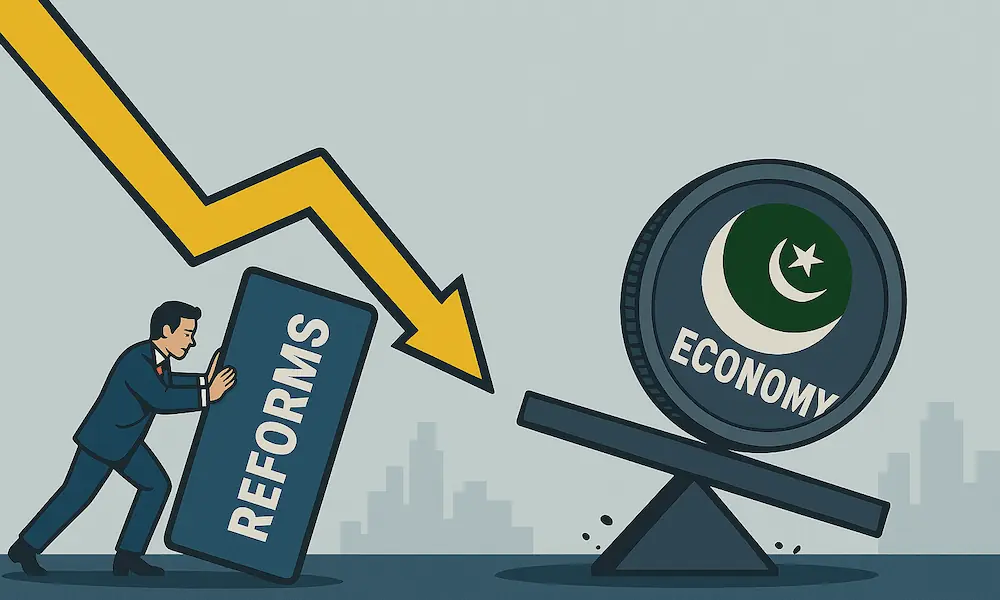
- The article argues that ambitious economic targets are unattainable without a coherent policy framework, citing a disconnect between government plans and the IMF's contractionary monetary and taxation policies.
Pakistan is pursuing ambitious economic targets without a clear policy framework, a situation likened to entering a cricket match without a bat. The country has long sought investments, particularly Foreign Direct Investment (FDI), believing Pakistan offers attractive opportunities. However, the investment-to-GDP ratio, which averaged 18% for nearly 40 years until 2018, plummeted from 17.2% that year to 15.5% in 2019, the first year of the International Monetary Fund’s (IMF) ‘stabilisation’ program. It hit a historic low of 13.1% of GDP in 2024. Concurrently, FDI fell from 1% to 0.5% of GDP over the same period.
Governments communicate with investors primarily through their policies, enabling them to anticipate future directions. The absence of a clear, consistent, and predictable policy environment fosters speculative activities while constraining long-term investment horizons and risk appetite, according to the Pakistan Policy Dialogue 2026. The core challenge is not a lack of opportunities, but the failure to create a policy environment that makes these opportunities commercially viable and attractive.
The primary obstacle to achieving economic ambitions is the disconnect between Pakistan's plans and its policies. Key government documents, such as Uraan Pakistan (2024-30) and the prime minister’s Economic Transformation Agenda and Implementation Plan (2024-2029), target annual economic growth of 6-7% and a 43% increase in per capita income by 2029-30. In stark contrast, the economic team adheres strictly to the IMF program's contractionary monetary policy, characterized by high real interest rates (4-5% above inflation), and a very high, punitive taxation policy. This divergence explains why growth targets have consistently been missed.
Furthermore, the article criticizes the "gaslighting effect" of donor pronouncements on domestic followers. Many have been led to believe that IMF-dictated contractionary policies have stabilized the economy, overlooking their severe impact on socio-economic indicators. The author recalls warning the prime minister in May 2019, before leaving the position of finance secretary, that the poorly negotiated IMF program would stifle growth, increase poverty, and drive up unemployment. These warnings, unfortunately, have materialized without any sign of relief since 2019.
DistantNews Editorial
Originally published by Dawn in English. Translated, summarized, and contextualized by our editorial team with added local perspective. Read our editorial standards.
More Stories



From Our Blog

What Gets Lost (and Found) When News Is Translated

The Critical Role of Diaspora Media in Global News

What Travellers Should Know About Countries with Restricted Press

A Digital Nomad's Guide to Following Local News

How the Same Story Looks Different in Different Countries
