


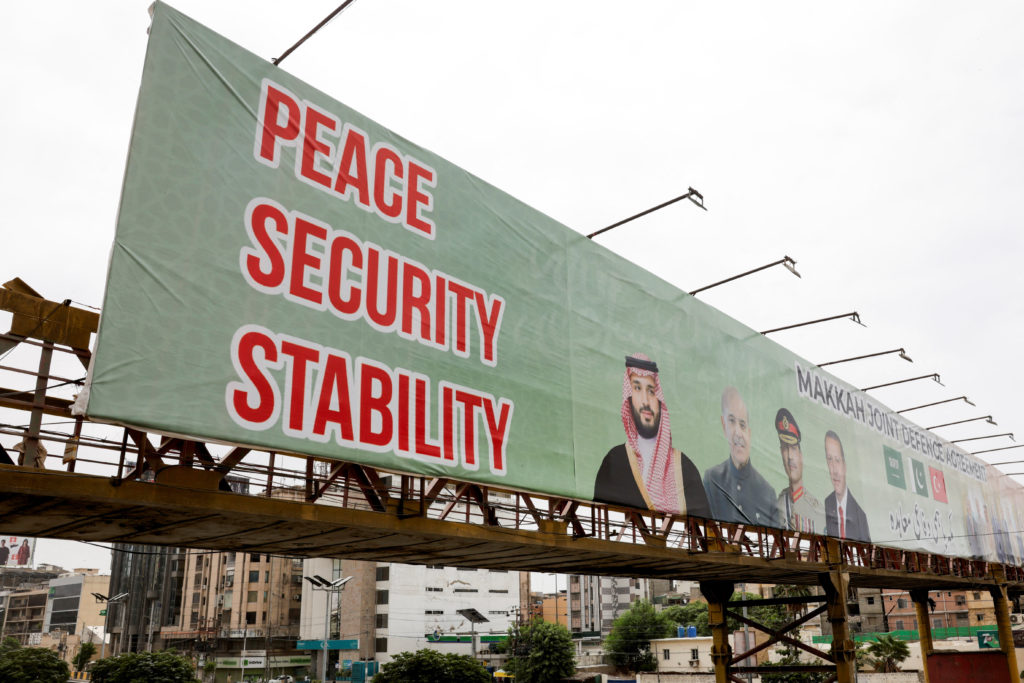
Pakistan, Saudi Arabia, Turkey Sign 'Purely Defensive' Pact Open to Others
Translated from English, summarized and contextualized by DistantNews.
At a glance
News
Named sources
New plan
- Pakistan, Saudi Arabia, and Turkey have signed a new 'purely defensive' joint defense agreement.
- The pact, signed in Mecca, is open to other regional nations willing to uphold its principles.
- The agreement stipulates that an attack on one signatory is an attack on all, aligning with the UN Charter's self-defense principles.
Pakistan's foreign minister has stated that a new defense agreement signed with Saudi Arabia and Turkey is "purely defensive" and remains open to other regional nations. The landmark Mecca Joint Defense Agreement, signed by Saudi Crown Prince Mohammed bin Salman, Turkish President Recep Tayyip Erdogan, and Pakistani Prime Minister Shehbaz Sharif, aims to deepen security cooperation amidst heightened regional tensions.
purely defensive in nature
Foreign Minister Ishaq Dar emphasized on X that the agreement is not directed against any specific country, including Iran. He noted that other nations can join if they are willing to uphold the pact's principles and resolve differences peacefully. Dar stated the agreement reflects a shared desire to strengthen strategic security cooperation and is consistent with Article 51 of the U.N. Charter regarding individual and collective self-defense. Turkish Foreign Minister Hakan Fidan echoed similar sentiments, asserting the agreement was not aimed at Iran or any other nation.
that any armed attack against any one of the three states shall be regarded as an attack against them all
The agreement stipulates that an armed attack against any one of the three states will be regarded as an attack against all. This collective defense provision has led to public celebrations in Pakistan and Saudi cities, with landmarks illuminated in the flags' colors. While the three nations bring distinct capabilities, Pakistan's military experience and nuclear status, Saudi Arabia's economic resources, and Turkey's large military and defense industry, analysts caution against viewing it as a direct equivalent to NATO. The accord does not abrogate existing bilateral or multilateral agreements.
The Makkah Accord does not abrogate or replace any existing bilateral or multilateral agreements between these countries, or with other countries or organizations.
DistantNews Editorial
Originally published by PBS NewsHour in English. Translated, summarized, and contextualized by our editorial team with added local perspective. Read our editorial standards.
More Stories


From Our Blog

How the Same Story Looks Different in Different Countries

What Gets Lost (and Found) When News Is Translated

The Critical Role of Diaspora Media in Global News

What Travellers Should Know About Countries with Restricted Press

A Digital Nomad's Guide to Following Local News
