


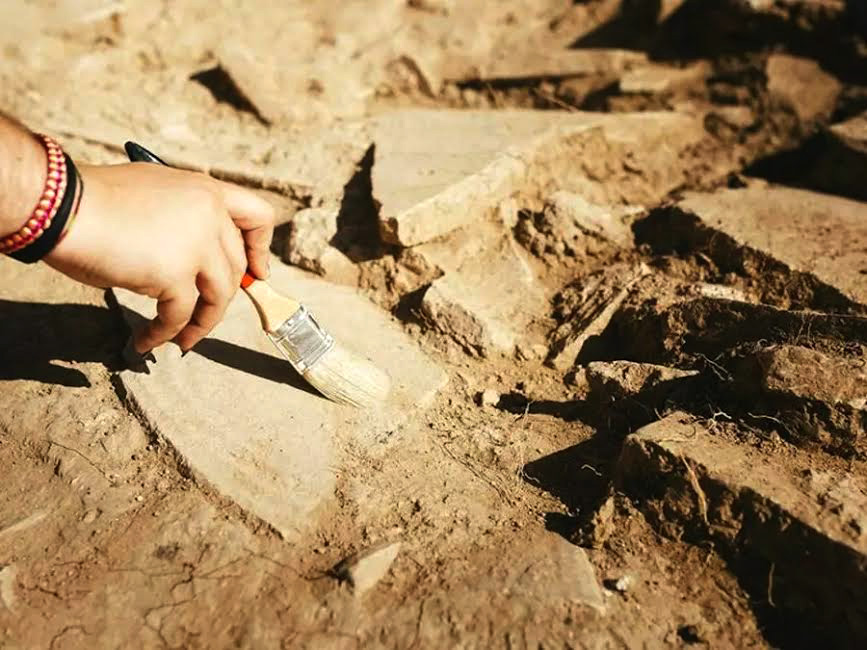
Paleolithic Site in Algeria Yields Million-Year-Old Elephant Tusk
Translated from French, summarized and contextualized by DistantNews.
At a glance
News
Sources not specified
Context piece
- Researchers in Algeria discovered an elephant tusk at the Tighenif Paleolithic site.
- The tusk is believed to belong to the extinct "Atlas elephant" and dates back to the Lower and Middle Pleistocene.
- This significant find, measuring 2.35 meters, was found alongside other fossils and stone tools.
An archaeological expedition at the Tighenif Paleolithic site in Algeria has yielded a remarkable discovery: a well-preserved elephant tusk. Researchers from the National Centre for Prehistoric, Anthropological, and Historical Research (CNRPAH) in Algiers unearthed the artifact during the eleventh excavation campaign.
The tusk is attributed to the "Atlas elephant," an extinct species that once roamed North Africa. Preliminary dating places it in the Lower and Middle Pleistocene epochs, approximately one million years ago. The find is considered one of the most significant of the ongoing scientific mission, according to researcher Mohamed Sahnouni.
Measuring an impressive 2.35 meters in length, the tusk is in a near-intact structural state, making it one of the most complete specimens ever found in the region. It was discovered within a sedimentary layer alongside other fossils of large mammals and Acheulean-tradition lithic tools, offering valuable insights into the prehistoric environment and fauna.
The tusk will be transferred to CNRPAH laboratories in Algiers for specialized analysis and restoration. These studies aim to provide a deeper understanding of its preservation and scientific significance. The excavations, led by Mohamed Sahnouni, are scheduled to continue until June 23, involving researchers and archaeology students from various Algerian universities.
This discovery was made as part of the eleventh excavation campaign currently underway, and I qualify it as one of the most important of this scientific mission.
DistantNews Editorial
Originally published by El Watan in French. Translated, summarized, and contextualized by our editorial team with added local perspective. Read our editorial standards.
More Stories

From Our Blog

What Gets Lost (and Found) When News Is Translated

The Critical Role of Diaspora Media in Global News

What Travellers Should Know About Countries with Restricted Press

A Digital Nomad's Guide to Following Local News

How the Same Story Looks Different in Different Countries
