


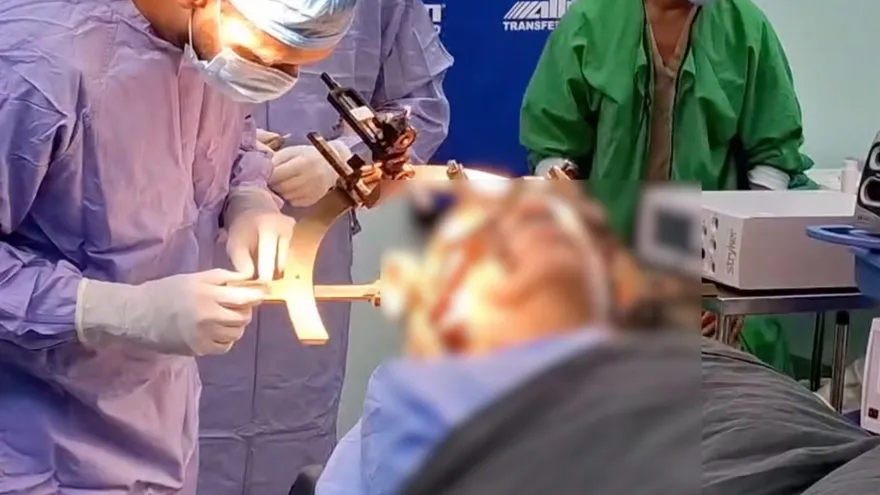

Panama performs its first complex robotic urological reconstructions
Translated from Spanish and summarized by DistantNews. Read the original for the full story.
At a glance
News
Named sources
Outcome reported
- Specialists at Panama’s Ciudad de la Salud performed the country’s first highly complex reconstructive urological surgeries using robotic assistance.
- The team completed three procedures involving urethral narrowing, ureteral narrowing and a rectourethral fistula.
- The surgeries included training with U.S. reconstructive surgeon Lee C. Zhao, with the aim of helping local teams perform advanced procedures independently.
Panama’s Ciudad de la Salud has carried out the country’s first highly complex reconstructive urological surgeries with robotic assistance, opening another treatment option for patients with urinary-system complications.
The procedures took place with the participation of Dr. Lee C. Zhao, a reconstructive surgeon from New York, who worked with the local medical team and helped transfer advanced surgical techniques. The specialists performed three complex operations.
One procedure repaired a urethral stricture in a patient who had undergone a prostatectomy, with the goal of restoring proper urinary flow. A second reconstructed a narrowed ureter in a patient whose bladder had been removed and who had received an ileal conduit diversion. The third repaired a rectourethral fistula, an abnormal connection between the urethra and rectum that can cause urinary or fecal leakage.
The team used recently introduced robotic systems, including the Toumai platform. The technology allows more precise visualization of the surgical field and greater precision when placing deep sutures.
Dr. Elías Bodden, head of urology at Ciudad de la Salud, said the integration of robotic tools and training in functional and aesthetic reconstructive techniques aims to strengthen Panama’s medical capabilities. Zhao said the central goal of the exchange was for local surgical teams to adopt the advanced approaches independently, reducing the need to send men and women abroad for complex urinary-tract conditions.
The central goal of the exchange is for local surgical teams to adopt these high-complexity approaches autonomously, reducing the need for international referrals for urinary-tract conditions in men and women.
About this summary
Originally published by TVN Panamá in Spanish. Translated, summarized, and contextualized automatically by DistantNews, with a note on how the source frames the story. Not individually reviewed before publishing. How this works.
More Stories


From Our Blog

News in Translation: What Gets Lost, and How We Keep the Framing

Diaspora Media: How Communities Follow News From Home

Traveling Where the Press Is Not Free: How to Read the News There

The Digital Nomad's Guide to Local News

The Same Story, Different Countries: How Coverage Changes at the Border
