


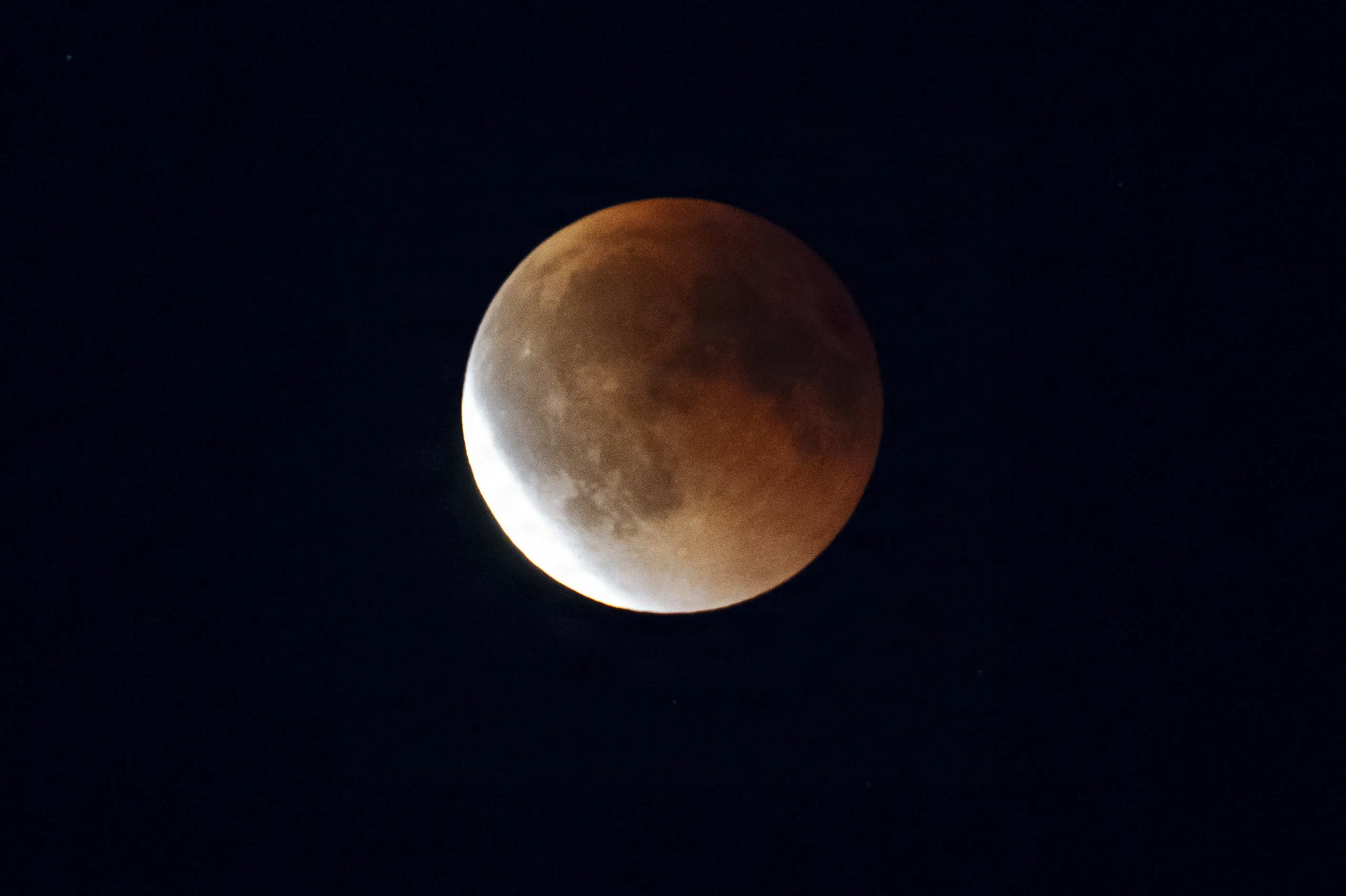
Partial lunar eclipse to cast reddish hue over Denmark Friday morning
Translated from Danish and summarized by DistantNews. Read the original for the full story.
At a glance
News
From a news agency
Context piece
- Denmark will witness a partial lunar eclipse early Friday morning, less than three weeks after a solar eclipse.
- Approximately 93 percent of the full moon will be obscured by the Earth's umbra around 6:30 AM.
- While not a total "blood moon," the obscured portion of the moon will take on a reddish glow due to sunlight scattering through Earth's atmosphere.
Stargazers in Denmark have another celestial event to anticipate this week, with a partial lunar eclipse set to grace the morning sky on Friday. This astronomical phenomenon follows closely on the heels of a recent solar eclipse, offering a new spectacle for skywatchers.
The eclipse is expected to reach its peak around 6:30 AM, when a significant portion of the full moon, up to 93 percent of its diameter, will be enveloped by the Earth's darkest shadow, known as the umbra.
Although the eclipse will not be total, meaning the moon won't completely disappear or turn a deep red often referred to as a "blood moon," a noticeable reddish hue is anticipated. This coloration occurs as sunlight filters through Earth's atmosphere, scattering blue light and allowing red light to pass through and illuminate the moon's surface.
Astrofyicist Michael Linden-Vørnle from the Technical University of Denmark explained that this scattering effect is the same phenomenon that causes the vibrant red colors seen during sunrises and sunsets. The partial lunar eclipse provides a beautiful, albeit less dramatic, display of this atmospheric interaction.
It makes it so because the Earth's shadow is filled with red light - the red sunlight that is scattered through the Earth's atmosphere, and that is what makes our sunrises and sunsets red.
About this summary
Originally published by Berlingske in Danish. Translated, summarized, and contextualized automatically by DistantNews, with a note on how the source frames the story. Not individually reviewed before publishing. How this works.
More Stories


From Our Blog

What Gets Lost (and Found) When News Is Translated

The Critical Role of Diaspora Media in Global News

What Travellers Should Know About Countries with Restricted Press

A Digital Nomad's Guide to Following Local News

How the Same Story Looks Different in Different Countries
