


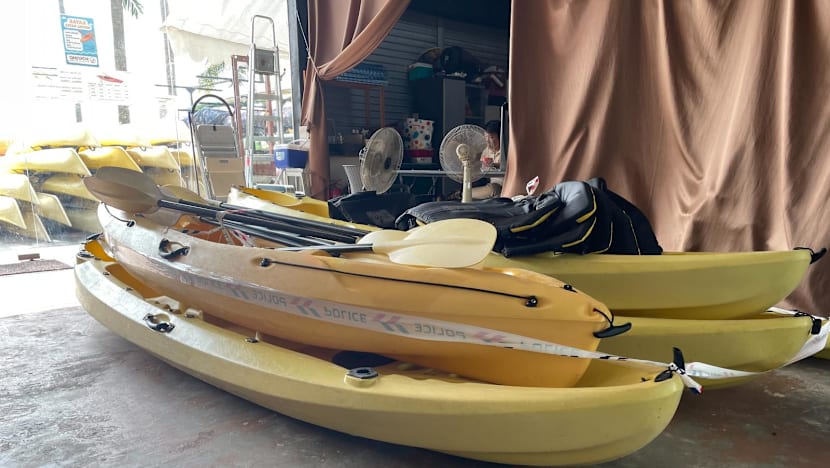
Pasir Ris lightning death prompts safety review among outdoor sports operators
Summarized and contextualized by DistantNews.
At a glance
News
Sources not specified
Context piece
- An outdoor sports operator is reviewing safety protocols after a man died from a lightning strike while paddleboarding in Singapore.
- Existing procedures require stopping activities at the first sign of dangerous weather, but operators also rely on visual and auditory cues.
- The incident prompts questions about how outdoor activities should respond to rapidly changing weather conditions.
Outdoor sports operators in Singapore are re-evaluating their safety procedures following the death of a man struck by lightning while paddleboarding last Sunday. Despite existing protocols mandating the cessation of activities at the first indication of hazardous weather, instructors often depend on real-time observations of conditions at sea.
Once we see the flash of lightning, we start counting to see when the thunder reaches us, and that's how we know how far it is.
Mohammad Nordin, founder of Fish On, a kayak rental and tour company, explained that his business uses both official lightning alerts from the National Environment Agency (NEA) and on-site observations. He described a method of counting seconds between lightning flashes and thunder to estimate distance, aiming to reach shelter when lightning is within 6km. However, he noted that faint lightning at this distance can be difficult to detect.
Ideally, when lightning is 6km away, we need to start heading to the nearest shelter. If it's 3km away, we should be close to a shelter and if it's 1km, we should all be under the shelter. But in reality, at 6km, the lightning is usually quite faint, so we might not see it.
Nordin also pointed out the limitations of on-site lightning warning systems, which use lights and sirens. These systems can be ineffective for those farther offshore, as alarms may not be audible beyond 300 meters from shore, and visual signals can be obstructed by trees. He aims to plan routes that allow participants to reach shelter within 30 minutes if the weather turns.
We can hear the alarm if we're nearby but if we're more than 300m from shore, you can't really hear it. Even though they have lights, you can't see them from the sea because there are so many trees blocking it.
This incident follows a similar tragedy less than two months prior, where a worker at a Lim Chu Kang fish farm died after being struck by lightning. The recent death of Mikhail Benyamin, a freelance sea sports instructor, while paddleboarding off Pasir Ris Beach, has intensified scrutiny on safety measures for outdoor activities in rapidly changing weather. Outdoor Adventures, the company associated with the paddleboards Benyamin used, stated it would enhance instructor training on weather awareness and navigating sea conditions. Another operator, Adventures by Asian Detours, also reported reviewing its safety measures immediately after learning of the incident.
In my many years of kayak fishing, I have never come across this, so it was really a surprise. I don’t know if there’s much we can improve on but I want to talk to other operators to see if there’s anything we can do.
DistantNews Editorial
Originally published by CNA. Summarized and contextualized by our editorial team with added local perspective. Read our editorial standards.
More Stories



From Our Blog

What Gets Lost (and Found) When News Is Translated

The Critical Role of Diaspora Media in Global News

What Travellers Should Know About Countries with Restricted Press

A Digital Nomad's Guide to Following Local News

How the Same Story Looks Different in Different Countries
