


Past: Klöckner Calls GDR Comparisons to Today's Situation Absurd
Translated from German, summarized and contextualized by DistantNews.
At a glance
News
From a news agency
Context piece
- German Bundestag President Julia Klöckner dismissed comparisons of the current political situation to the former East Germany (GDR) as absurd.
- She emphasized the harshness of the GDR regime for dissidents and contrasted it with current freedoms.
- The comments were made during a visit to the Hohenschönhausen memorial, a former Stasi prison.
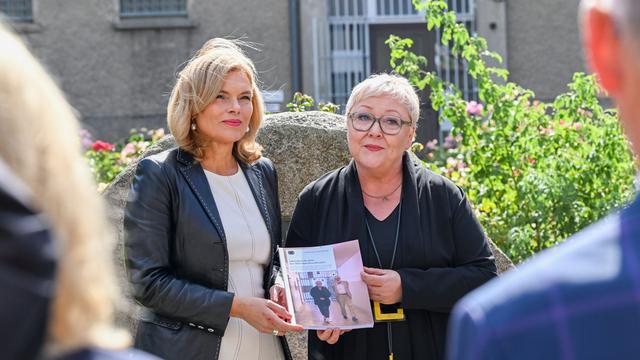
Bundestag President Julia Klöckner has strongly rejected comparisons between contemporary Germany and the former East German (GDR) regime, calling such notions "absurd." Speaking at the Hohenschönhausen memorial, a former prison of the Stasi secret police, Klöckner highlighted the stark differences in freedom and state repression.
If today people talk about there being no freedom of speech, that Germany is close to a dictatorship, and such things that one finds on the internet, that is absurd, when one also looks at what was experienced in the GDR.
"If today people talk about there being no freedom of speech, that Germany is close to a dictatorship, and such things that one finds on the internet, that is absurd when one also looks at what was experienced in the GDR," Klöckner stated during a tour of the former prison. She emphasized that critics of the regime in the GDR faced the full force of its punitive measures.
Germany must never again be a place of state arbitrariness and tyranny.
Klöckner's remarks were made shortly before the 65th anniversary of the Berlin Wall's construction on August 13. She thanked survivors who shared their experiences of imprisonment, stressing that "Germany must never again be a place of state arbitrariness and tyranny." The visit underscored the importance of remembering the past to prevent future abuses of power.
The shadow of the dictatorship is long.
Evelyn Zupke, the Commissioner for the Victims of the SED Dictatorship, noted that the "shadow of the dictatorship is long," with many still suffering health consequences. While acknowledging progress in victim support, Zupke also called for more aid for victims of state-sponsored doping in the GDR, citing the "State Plan 14.25" which systematically doped thousands of young athletes without their knowledge to demonstrate socialist superiority.
The GDR sports system did not just produce medals and world champions. State-sponsored doping is responsible for thousands of people who suffer from physical and psychological consequences to this day.
DistantNews Editorial
Originally published by Die Zeit in German. Translated, summarized, and contextualized by our editorial team with added local perspective. Read our editorial standards.
More Stories



From Our Blog

What Gets Lost (and Found) When News Is Translated

How the Same Story Looks Different in Different Countries

The Critical Role of Diaspora Media in Global News

What Travellers Should Know About Countries with Restricted Press

A Digital Nomad's Guide to Following Local News
