


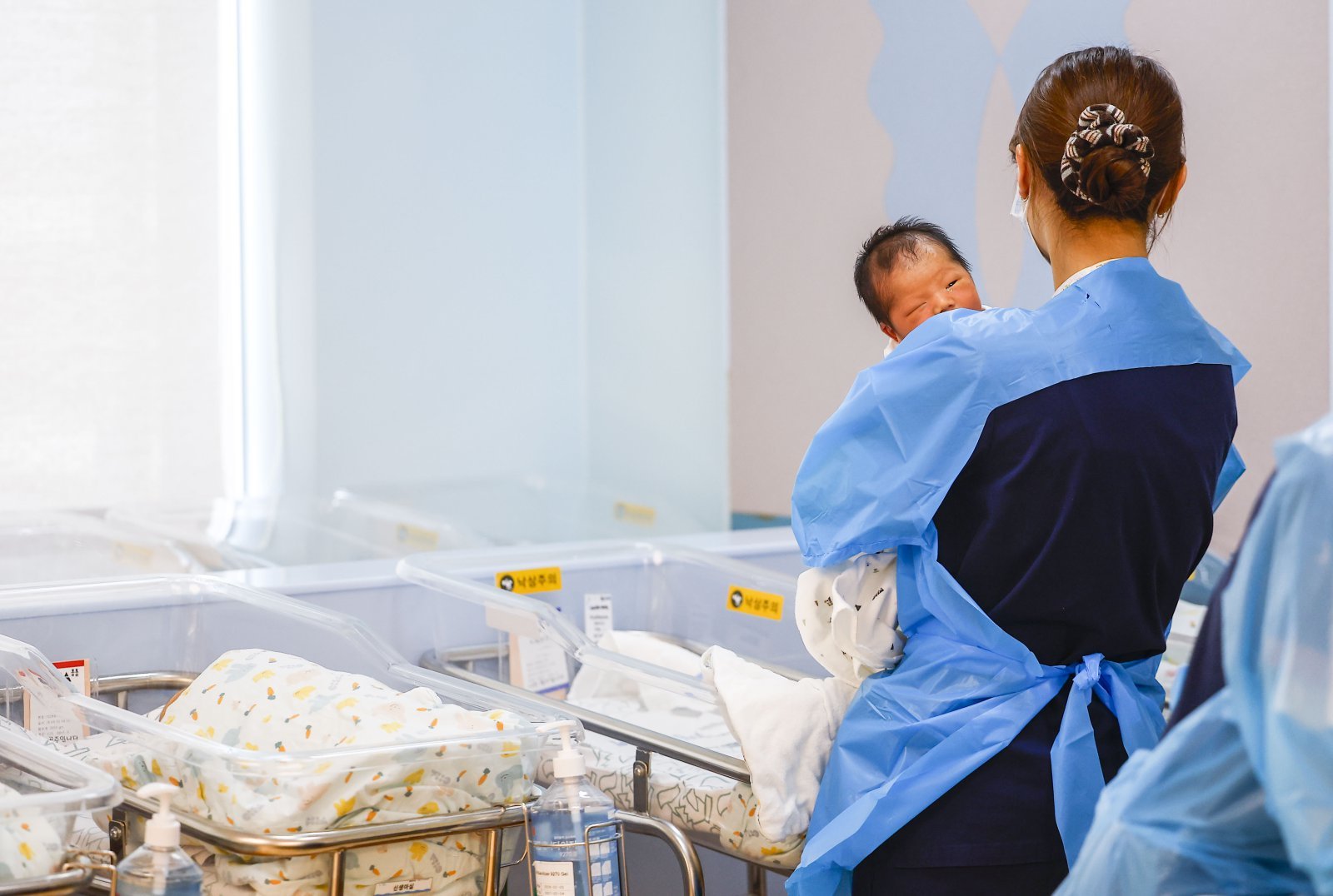
Personal willingness, not money, drives South Korean birth decisions: study
Translated from Korean, summarized and contextualized by DistantNews.
At a glance
Analysis
Documents & data
Context piece
- A South Korean study found that personal and spousal willingness are the most significant factors influencing decisions to have children, outweighing financial stability, housing, or childcare support.
- The research, based on a 2024 survey, indicated that factors like age, health, and spousal support in household chores and childcare also play a role, but less so than personal desire.
- Experts suggest that addressing South Korea's low birth rate requires tackling deep-rooted structural issues beyond short-term policies, while acknowledging recent upticks in births may be influenced by demographic shifts and increased marriage rates post-COVID-19.
Personal and spousal willingness are the most crucial factors driving decisions to have children in South Korea, according to a recent study, surpassing financial concerns, housing stability, or childcare support.
The findings, presented at the 42nd Population Forum by the Low Birth Rate and Aging Society Committee and the Korea Institute for Health and Social Affairs, are based on a 2024 survey of individuals who have had children. The survey used a 5-point scale, with personal willingness to have a child scoring highest at 4.24, closely followed by a spouse's willingness at 4.2. Other significant factors included the age and health of both partners (4.09), spousal support with household chores and childcare (3.85), and housing stability (3.81).
The factors influencing the decision to have children are not money, housing, or childcare support, but rather the willingness of the individual and their spouse.
Financial stability ranked sixth (3.8), followed by work-life balance support (3.7), childcare facility availability (3.6), government low-birth rate policies (3.57), and anxieties about the future (3.24). Family and relative support for childcare ranked lowest among the factors considered (3.14).
The population problem is not a task that can be solved with short-term measures, as it is a concentrated result of all structural contradictions in our society, including employment, housing, education, and gender.
Researchers noted a recent increase in birth rates, with February 2026 seeing the highest number of births for that month since 2019. This trend is attributed to a combination of factors, including an increase in marriages post-COVID-19, policy effects, and the entry of the "echo-boom" generation into their 30s. However, concerns remain about the rising average age of childbirth (33.8 in 2025) and the increasing proportion of childless couples.
Experts emphasize that tackling South Korea's persistently low birth rate requires addressing complex structural issues across employment, housing, education, and gender dynamics. They advocate for long-term, evidence-based research and policy interventions rather than short-term solutions. The study also explored reasons for delayed marriage, with respondents citing difficulty finding a suitable partner, housing costs, and job instability as primary barriers.
Creating a society where young people can dream of the future and raising children is a blessing is the responsibility of all of us and the government.
DistantNews Editorial
Originally published by Dong-A Ilbo in Korean. Translated, summarized, and contextualized by our editorial team with added local perspective. Read our editorial standards.
More Stories


From Our Blog

What Gets Lost (and Found) When News Is Translated

The Critical Role of Diaspora Media in Global News

What Travellers Should Know About Countries with Restricted Press

A Digital Nomad's Guide to Following Local News

How the Same Story Looks Different in Different Countries
