


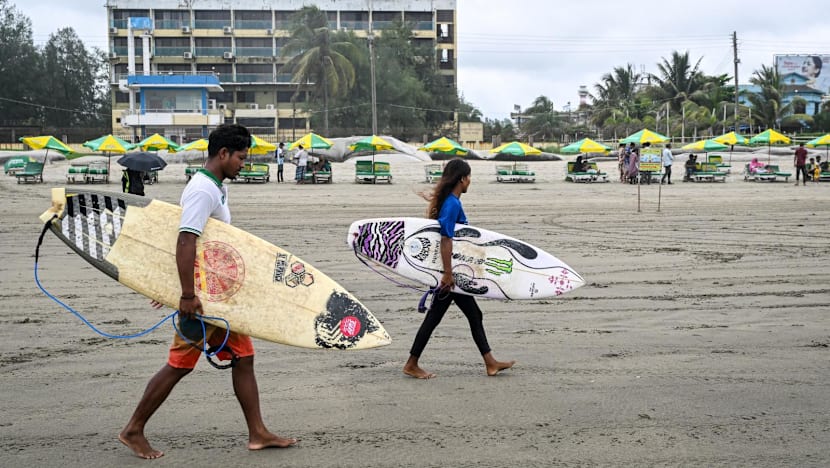
Pipe dreams: Bangladesh surfers chase waves at Asian Games
Summarized and contextualized by DistantNews.
At a glance
In-depth
Named sources
Context piece
- Bangladeshi surfers Fatima Akhter and Mohammad Mannan are preparing for the Asian Games, where surfing debuts.
- They aim to popularize the sport in Bangladesh, which is dominated by cricket and football.
- Both surfers have overcome personal challenges and stigma to pursue their passion.
In Cox's Bazar, Bangladesh, surfers Fatima Akhter and Mohammad Mannan are riding the waves with aspirations beyond the Bay of Bengal. They are training for the upcoming Asian Games in Japan, an event that marks surfing's debut, hoping to carve out a niche for the sport in a nation captivated by cricket and football. The Bangladesh Surf Girls and Boys Club, based in a humble shack, houses ambitions as vast as the 120km coastline.
The moment I step onto the board, I forget everything else. When I successfully ride a wave, I feel happy and fulfilled. The feeling is impossible to describe.
Akhter, a 16-year-old, has faced significant stigma in the Muslim-majority country to excel as a young female surfer. "The moment I step onto the board, I forget everything else," she shared. "When I successfully ride a wave, I feel happy and fulfilled. The feeling is impossible to describe."
Mannan, 25, began his journey selling seashell jewelry to support his family before discovering surfing. Initially encouraged by his parents to focus on studies, he persisted, believing in the sport's future growth. "Surfing isn't a lucrative sport in Bangladesh now, but nobody can say it never will be," he stated.
Surfing isn't a lucrative sport in Bangladesh now, but nobody can say it never will be.
Despite limited opportunities and facing larger waves internationally compared to Bangladesh's typical five-foot swells, Mannan studies top surfers like John John Florence via YouTube to hone his skills. Club founder Rashed Alam acknowledges the challenges, noting the disparity in equipment and travel opportunities for Bangladeshi surfers compared to their international counterparts.
Surfers from other countries are different, because they have better boards, bigger waves, and travel frequently to different countries. It's impossible to understand an ocean if you've never surfed there.
DistantNews Editorial
Originally published by CNA. Summarized and contextualized by our editorial team with added local perspective. Read our editorial standards.
More Stories



From Our Blog

What Gets Lost (and Found) When News Is Translated

The Critical Role of Diaspora Media in Global News

What Travellers Should Know About Countries with Restricted Press

A Digital Nomad's Guide to Following Local News

How the Same Story Looks Different in Different Countries
