


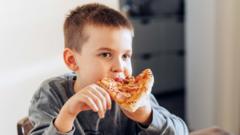
Pizza, Pasta, Potatoes: How Italian Children Became So Overweight
Translated from English, summarized and contextualized by DistantNews.
At a glance
News
Sources not specified
Context piece
- Italian children are experiencing a significant rise in obesity, particularly in the south, despite the country's Mediterranean diet reputation.
- Doctors are seeing younger patients with severe obesity, with some cases too risky for surgery.
- Cultural perceptions and a lack of awareness contribute to the problem, though schools and initiatives are trying to educate families.
Daily life is a struggle for 17-year-old Salvatore, who weighs 170kg and faces mobility issues, unable to tie his shoelaces or use his Vespa scooter without breaking its wheels. His mother, Anna, notes he "eats constantly." Salvatore is among a growing number of Italian children and teenagers battling obesity, a problem particularly acute in the south, where over 40% of eight and nine-year-olds in parts of the Campania region are overweight. The town of Ponticelli, near Naples, has gained notoriety as a child obesity capital, a stark contrast to Italy's image as the home of the Mediterranean diet. According to the World Health Organization (WHO), Italian children are now among the most overweight in Europe. Salvatore awaits life-changing surgery at Betania Hospital in Ponticelli, where Dr. Sonja Chiappetta has treated severe obesity for 15 years. She observes a disturbing trend: "Now I see those same patients when they're teenagers, as young as 16. They are getting younger, and it's frightening." The surgery, which removes up to 90% of the stomach, is in high demand, but Salvatore's excessive weight makes it too dangerous. He has been prescribed a GLP-1 weight-loss injection to help him shed enough weight for the operation. At Ugo Foscolo primary school, the gym is cramped. Teacher Francesca Pecce worries about a 10-year-old pupil weighing around 60 kilograms. She has tried discussing the issue with his mother, but "she is not worried." Pecce explains, "In Neapolitan culture, if a child is a little chubby with rosy cheeks, people often think they're healthy." Schools, she believes, can help shift this perception, especially by educating parents through their children. A nutrition workshop at a secondary school in Naples, part of a regional initiative targeting childhood obesity, aims to involve over 17,000 students across 25 schools. Families will receive support to change eating habits at home, though not all students are convinced. The WHO labels obesity an "escalating global epidemic," with over a billion people worldwide now obese and childhood obesity having quadrupled since 1990. In 2025, Italy became the first country to legally recognize obesity as a chronic, progressive, and relapsing disease.
He eats constantly
DistantNews Editorial
Originally published by BBC News in English. Translated, summarized, and contextualized by our editorial team with added local perspective. Read our editorial standards.
More Stories



From Our Blog

What Gets Lost (and Found) When News Is Translated

The Critical Role of Diaspora Media in Global News

What Travellers Should Know About Countries with Restricted Press

A Digital Nomad's Guide to Following Local News

How the Same Story Looks Different in Different Countries
