


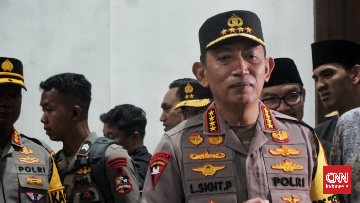
Police Chief responds to proposal for civilians in police roles
Translated from Indonesian, summarized and contextualized by DistantNews.
At a glance
News
Sources not specified
Context piece
- Indonesian National Police Chief General Listyo Sigit Prabowo responded to a proposal to allow civilians into certain police positions.
- Prabowo stated that the police already have a reciprocal mechanism allowing civil servants (ASN) into the police force.
- The proposal, made by Human Rights Minister Natalius Pigai, suggests civilian oversight in managerial, financial, and technological roles within the police, drawing parallels with international practices.
Indonesian National Police Chief General Listyo Sigit Prabowo has addressed a proposal suggesting that civilian personnel could fill certain positions within the police institution. The idea, put forth by Human Rights Minister Natalius Pigai, advocates for incorporating civilian oversight, a concept known as "civilian oversight," into the Indonesian National Police (Polri).
Yes, we are providing a reciprocal space for ASN to enter the police, that's right. When we are given space outside the structure, we also provide space for ASN from outside Polri to enter Polri.
Prabowo indicated that Polri already practices a reciprocal mechanism, which allows civil servants (ASN) to enter the police force. He explained that this is in line with instances where police personnel are given opportunities to serve in positions outside the police structure. "Yes, we are providing a reciprocal space for ASN to enter the police, that's right. When we are given space outside the structure, we also provide space for ASN from outside Polri to enter Polri," Prabowo told reporters.
So why did I say civilians can be main officials in the police. All modern countries in the world, that's called civilian oversight. Civilian oversight, almost all police leaders in all developed countries like in America, like in England, like in France, like in the Netherlands, their top leaders are civilians. Like the NYPD, yes, the NYPD's top leader is a civilian.
Minister Pigai's proposal, based on the "civilian oversight" principle common in many developed nations like the United States, the United Kingdom, and France, suggests that civilians could occupy key managerial, financial, technological development, planning, and human resource roles. Pigai emphasized that this is not about appointing a civilian as the National Police Chief, but rather about integrating civilian expertise into specific administrative and developmental functions.
We are not asking for the Police Chief to be a civilian, we are not asking for that. But managerial positions, financial positions, positions related to technology development, planning, human resources, those can actually be held by civilians. That is also part of what is called using the concept of civilian oversight.
Pigai further argued that implementing civilian oversight could help dismantle the perceived dichotomy between civilian and security apparatus personnel, which has historically led to friction. He believes that by allowing mutual integration, such as civilians serving in police roles and police officers serving in civilian capacities, the historical "civil-military" or "police-civilian" conflicts could diminish, fostering greater harmony within the country.
The civil-military dichotomy, the police and civilian dichotomy, will be erased automatically because there are civilians in the TNI-Polri, there are TNI-Polri in the civilian wilayah so the dichotomy of fighting all this time will disappear by itself. Yes, this is actually me helping to reconcile the conflict between civilians and the military in Indonesia.
DistantNews Editorial
Originally published by CNN Indonesia in Indonesian. Translated, summarized, and contextualized by our editorial team with added local perspective. Read our editorial standards.
More Stories


From Our Blog

What Gets Lost (and Found) When News Is Translated

The Critical Role of Diaspora Media in Global News

What Travellers Should Know About Countries with Restricted Press

A Digital Nomad's Guide to Following Local News

How the Same Story Looks Different in Different Countries
