


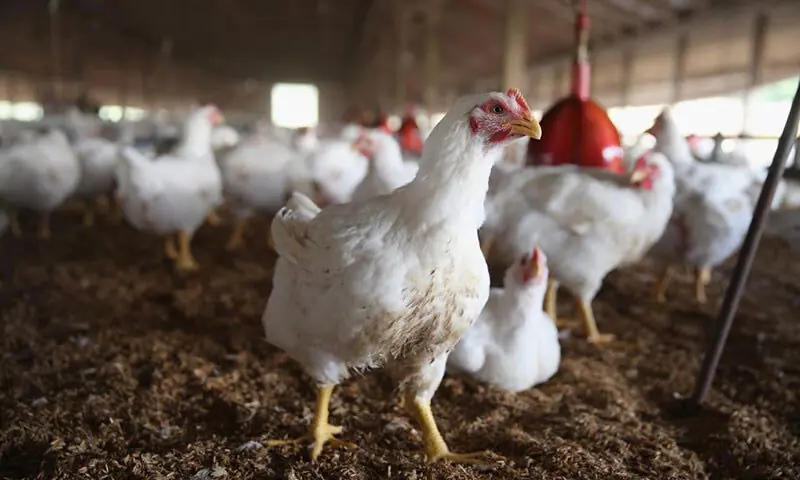
Poultry industry grows at consumers’ cost
Summarized and contextualized by DistantNews.
At a glance
News
Sources not specified
Context piece
- Pakistan's poultry sector grew 8% annually over the past decade, despite disease outbreaks, export suspensions, and rising costs.
- Live bird prices have fallen slightly post-Eidul Azha, but consumers have not seen significant price drops due to continued high demand and retailer pricing.
- Beef and mutton prices remain significantly higher than poultry, making chicken the more affordable option for low- and middle-income consumers.
Despite disease outbreaks, export suspensions, volatile market conditions, and increasing feed and production costs, Pakistan's poultry sector has maintained an annual growth rate of 8% over the last decade. While higher poultry prices may slow purchasing among low- and middle-income consumers, they continue to rely on chicken as it remains substantially cheaper than beef and mutton.
farm rate for live birds had plunged by Rs100 to Rs290-300 per kg after Eid, while the meat rate should not exceed Rs500 per kg, but retailers are charging over Rs500 per kg.
Following Eidul Azha, live bird prices in Karachi have decreased by an average of Rs100 per kg, settling between Rs370-420 per kg. Consumers had anticipated further price reductions, especially after the closure of the border with Afghanistan. However, poultry prices have shown an upward trend. In October 2025, after the Afghan border closure, live bird prices dropped to Rs310-360 per kg from Rs460-540 in September, but traders note that exports of poultry products like birds, feed, chicks, and eggs remain suspended, yet consumers haven't experienced significant price relief.
chicken remains affordable despite the impact of the Afghan border closure and the Middle East crisis, which also led to the suspension of poultry product shipments to Iran.
Kamal Akhtar Siddiqui, a member of the Pakistan Poultry Association's Executive Committee, stated that farm rates for live birds fell by Rs100 to Rs290-300 per kg after Eid. He believes the meat rate should not exceed Rs500 per kg, but retailers are charging more. Siddiqui emphasized that chicken remains affordable compared to red meat, with veal priced at Rs1,500-1,800 per kg and mutton at Rs2,700-2,900 per kg, prices beyond the reach of many.
Compared with red meat, chicken is still affordable for many low- and middle-income people, he said.
Demand for chicken has currently dipped as consumers' freezers are stocked with meat from sacrificial animals. Siddiqui expects demand to increase once this meat is consumed. Despite fluctuations in rates due to supply and demand, consumers have not yet seen a substantial price decrease.
Demand will pick up when sacrificial animal meat is fully consumed.
DistantNews Editorial
Originally published by Dawn. Summarized and contextualized by our editorial team with added local perspective. Read our editorial standards.
More Stories



From Our Blog

What Gets Lost (and Found) When News Is Translated

The Critical Role of Diaspora Media in Global News

What Travellers Should Know About Countries with Restricted Press

A Digital Nomad's Guide to Following Local News

How the Same Story Looks Different in Different Countries
