


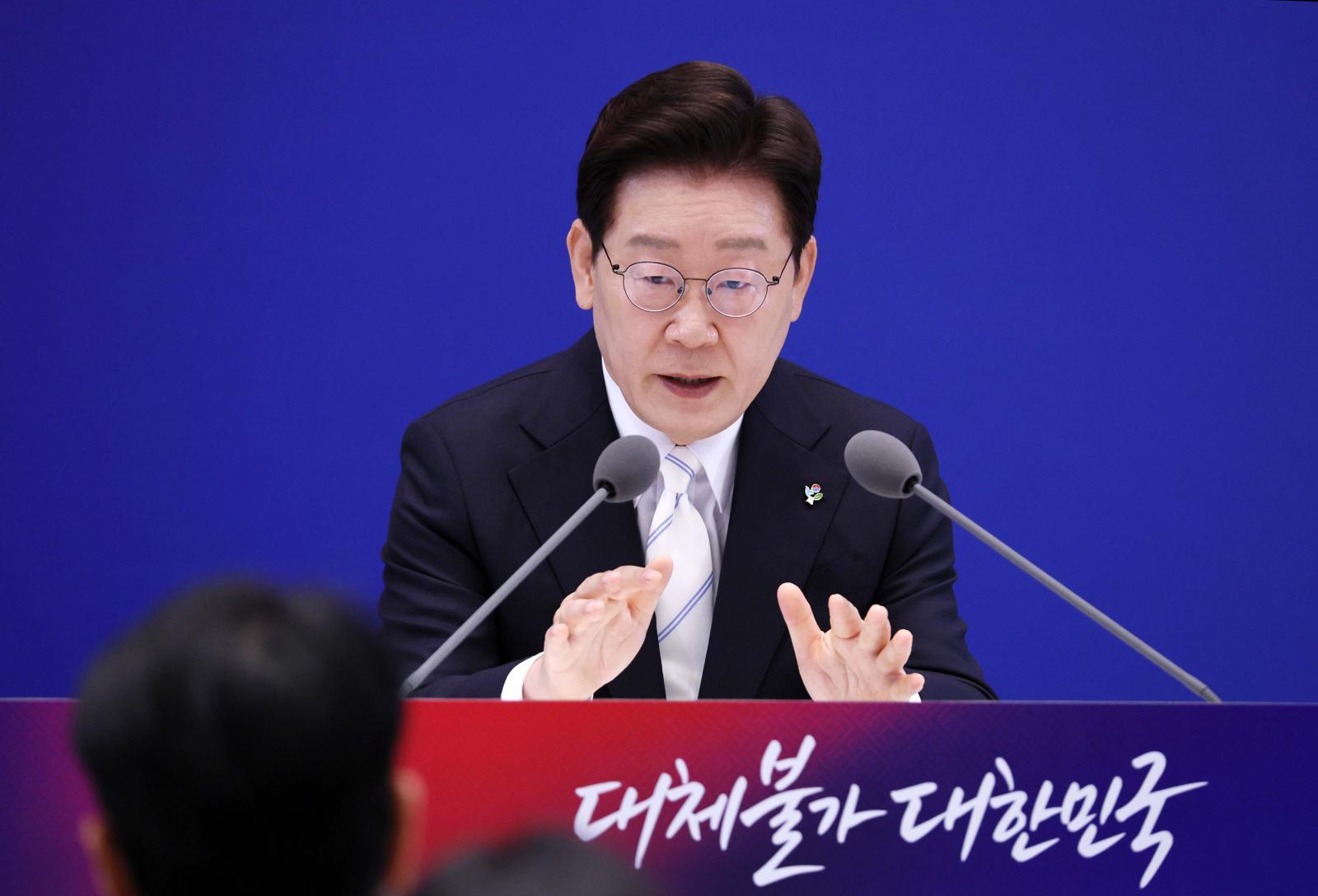
President Lee Attributes Election Success to Stable Housing Prices, Defends Policies
Translated from Korean, summarized and contextualized by DistantNews.
At a glance
News
Named sources
Context piece
- President Lee Jae-myung attributes the ruling party's success in local elections to stable housing prices.
- He claims his administration effectively managed rising housing pressures, preventing a significant surge.
- Lee also explained the shortage of jeonse (long-term rental) properties as a natural market adjustment.
South Korean President Lee Jae-myung believes the real estate market's stability positively influenced his party's performance in the recent local elections. Speaking at his first-anniversary press conference, Lee stated that housing prices were a "constant" factor in the election, arguing that his administration had successfully "blocked the pressure for rising prices" to a considerable extent.
Real estate was a constant in the elections. That is natural. It's not 'because of that,' but 'it exists naturally.'
Lee highlighted that public opinion on his administration's real estate policies was roughly split, with about 50% approval. He contrasted this with typical government approval ratings, which often see much lower support for housing policies. He suggested that without his "verbal interventions" since January, prices would have "skyrocketed," potentially impacting voter behavior negatively.
I believe I have blocked the pressure for rising prices to a considerable extent.
"If prices had surged, would people in those areas have voted for the Democratic Party?" Lee mused, indicating his belief that his actions prevented a worse outcome. He also addressed the recent shortage of jeonse, a type of long-term rental contract, characterizing it as a natural part of the market's normalization process.
If I hadn't suppressed it a bit with so-called verbal interventions starting in January, it would have skyrocketed.
Lee explained that the decrease in jeonse supply was due to a policy ending the deferral of capital gains tax for multi-homeowners, prompting many to sell their properties. He noted that while the perceived increase in jeonse prices might be significant due to lower supply, the overall market hadn't experienced a massive surge because the properties were purchased by those who intended to live in them. Looking ahead, Lee pledged to focus on supplying affordable, quality public rental housing for the middle class.
The supply of jeonse has decreased. That is natural. Because I ended the deferral of capital gains tax for multi-homeowners and told them to sell within that period, many sold.
DistantNews Editorial
Originally published by Dong-A Ilbo in Korean. Translated, summarized, and contextualized by our editorial team with added local perspective. Read our editorial standards.
More Stories


From Our Blog

What Gets Lost (and Found) When News Is Translated

The Critical Role of Diaspora Media in Global News

What Travellers Should Know About Countries with Restricted Press

A Digital Nomad's Guide to Following Local News

How the Same Story Looks Different in Different Countries
