


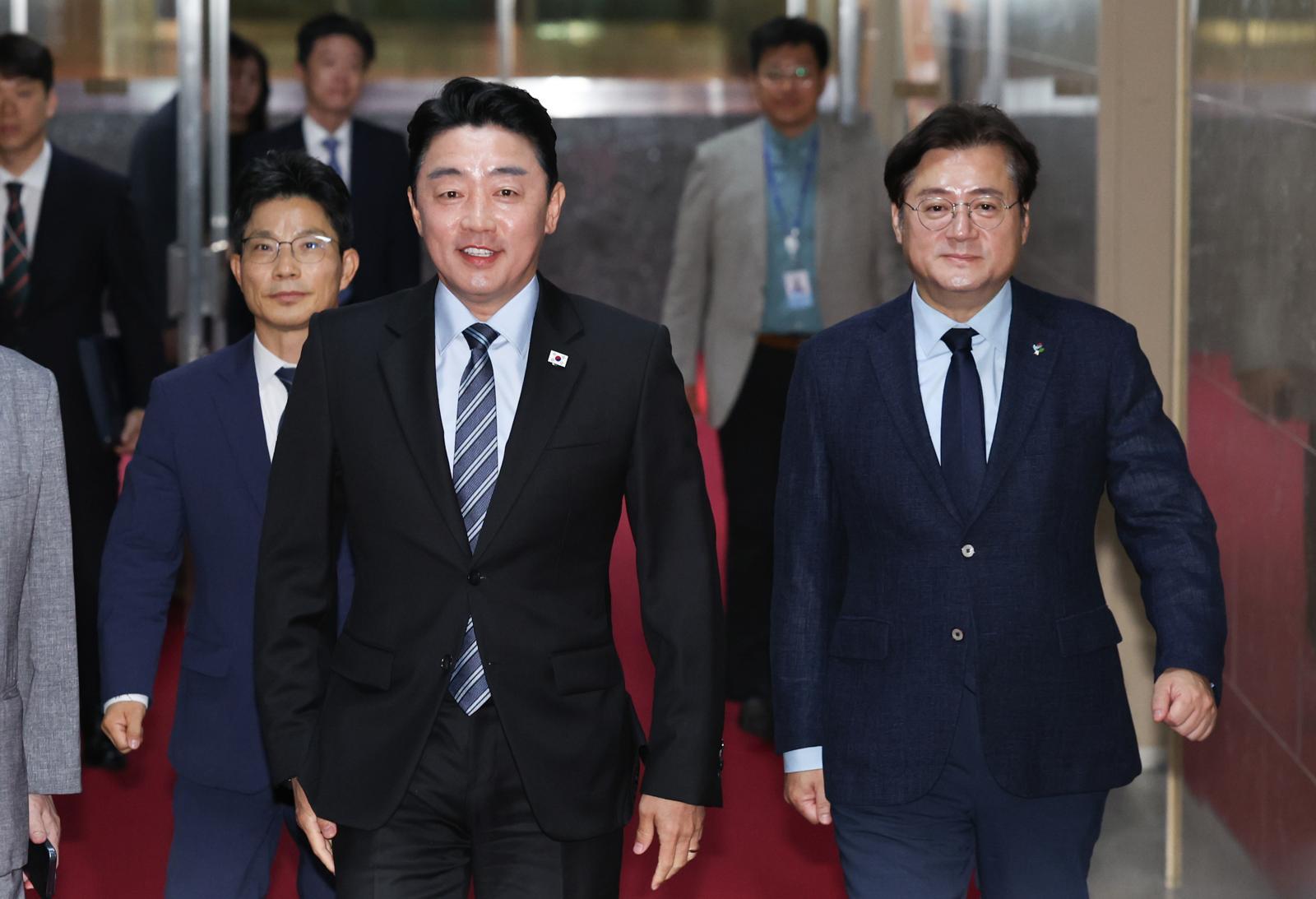
President Lee departs for G7; party leader's absence at send-off sparks debate
Translated from Korean, summarized and contextualized by DistantNews.
At a glance
News
Sources not specified
Context piece
- South Korean President Lee Jae-myung departed for the G7 summit, with his departure ceremony notably lacking a key party leader.
- The presidential office stated the reduced attendance was to minimize protocol and urged against overinterpretation.
- Disagreements exist regarding the significance of the party leader's absence, with some seeing it as a snub and others as a practical measure due to domestic political challenges.
South Korean President Lee Jae-myung embarked on his trip to the G7 summit, but the accompanying delegation at the airport departure ceremony sparked political discussion due to the absence of a prominent party figure.
The decision to limit attendees was made by the presidential office with the intention of minimizing protocol.
The presidential office moved quickly to address speculation surrounding the absence of Jeong Cheong-rae, the leader of the Democratic Party of Korea, from the send-off event. Kang Hoon-sik, a presidential secretary, explained to reporters that the decision to limit attendees was made by the presidential office with the intention of minimizing protocol. He emphasized that the absence should not be subject to "overinterpretation," suggesting it was a practical measure to streamline the event.
Despite the official explanation, some political observers interpreted Jeong's absence as a potential slight, a "passing" of the party leader. However, Kang refuted this, attributing the reduced delegation to the "difficult domestic situation" and reiterating the call for restraint in interpreting the event. The situation is further complicated by internal party dynamics, with Jeong reportedly being a contender for the next party leadership.
It should not be subject to 'overinterpretation,' suggesting it was a practical measure to streamline the event.
Adding to the nuanced political landscape, Kim Min-seok, the Prime Minister, who was also present at the ceremony, downplayed the significance of individual attendances. When asked about the Prime Minister's presence, he noted that attendance had varied for such events, implying that Jeong's absence was not an isolated or unusual occurrence. Hong Ik-pyo, a senior political secretary, also alluded to the "difficulties" of the current political climate, including election committee matters, as reasons for the minimized protocol, further suggesting that the focus should remain on the practicalities rather than political symbolism.
Attendance had varied for such events, implying that Jeong's absence was not an isolated or unusual occurrence.
DistantNews Editorial
Originally published by Dong-A Ilbo in Korean. Translated, summarized, and contextualized by our editorial team with added local perspective. Read our editorial standards.
More Stories


From Our Blog

What Gets Lost (and Found) When News Is Translated

The Critical Role of Diaspora Media in Global News

What Travellers Should Know About Countries with Restricted Press

A Digital Nomad's Guide to Following Local News

How the Same Story Looks Different in Different Countries
