


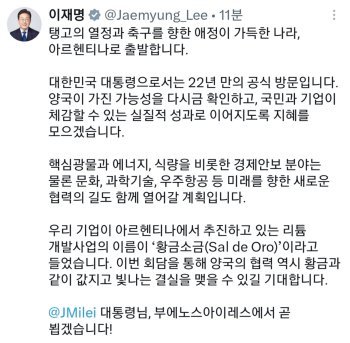
President Lee Highlights Posco's 'Golden Salt' Lithium Project in Argentina
Translated from Korean, summarized and contextualized by DistantNews.
At a glance
News
Named sources
New plan
- South Korean President Lee Jae-myung highlighted Posco's 'Golden Salt' lithium project in Argentina during his visit.
- Posco's Argentina lithium operation achieved its first quarterly profit in Q2 2026 and aims for 100% capacity utilization by year-end.
- The company plans to accelerate phases 3 and 4 of its lithium production, aiming for a total annual output of 100,000 tons by 2033.
South Korean President Lee Jae-myung has drawn attention to Posco Group's lithium development project in Argentina, dubbed 'Golden Salt' (Sal de Oro), ahead of his official visit to the country. Posco Holdings announced that its Argentine lithium operation recorded its first quarterly profit in the second quarter of 2026. The company plans to reach 100% capacity utilization for its first phase plant by the end of the year.
President Lee mentioned the project on his social media while en route to Argentina, expressing hope for fruitful bilateral cooperation akin to gold. He also emphasized strengthening economic security ties in areas like critical minerals, energy, and food. This visit marks the first official trip by a South Korean president to Argentina in 22 years, and Lee's explicit mention of Posco's lithium business is expected to positively influence local production expansion, subsequent investments, and the approval of investment incentives.
The 'Golden Salt' project involves extracting lithium-rich brine from the Hombre Muerto salt flat in Argentina to produce lithium hydroxide and carbonate for batteries. Posco Holdings acquired the Hombre Muerto salt flat mining rights in 2018 and has since secured additional rights. The current total estimated lithium brine resources stand at 15 million tons. The first phase plant, with an annual capacity of 25,000 tons, was completed in 2024. Following operational stabilization and improvements, the project achieved its first monthly profit in March 2026 and its first quarterly profit in Q2 2026. Posco expects further profitability improvements as product sales gain momentum after customer certification.
Posco Holdings is also nearing the completion of its second phase plant, also with a 25,000-ton annual capacity. While initial operating costs might impact third-quarter financials, profitability is projected to improve from the fourth quarter as production increases. The company is accelerating plans for phases 3 and 4, each with a 25,000-ton capacity, aiming to establish a total annual lithium production capacity of 100,000 tons in Argentina by 2033. The project awaits approval for Argentina's 'RIGI' large-scale investment incentive program, which offers benefits like corporate tax reductions and import duty exemptions, potentially boosting the project's profitability.
DistantNews Editorial
Originally published by Dong-A Ilbo in Korean. Translated, summarized, and contextualized by our editorial team with added local perspective. Read our editorial standards.
More Stories


From Our Blog

What Gets Lost (and Found) When News Is Translated

The Critical Role of Diaspora Media in Global News

What Travellers Should Know About Countries with Restricted Press

A Digital Nomad's Guide to Following Local News

How the Same Story Looks Different in Different Countries
