


President Lee's efforts to appease core supporters: Impact on party leadership race? [Analysis]
Translated from Korean, summarized and contextualized by DistantNews.
At a glance
Analysis
Sources not specified
Context piece
- The Democratic Party's leadership race is heating up, with key figures like former leader Chung Sye-kyun and Song Young-gil expected to announce their candidacies.
- President Lee Jae-myung appears to be maneuvering to prevent Chung's re-election, signaling a potential rift between the president and the party leadership.
- Concerns are rising about potential government instability and division within the party's core support base due to the intensifying internal conflict.
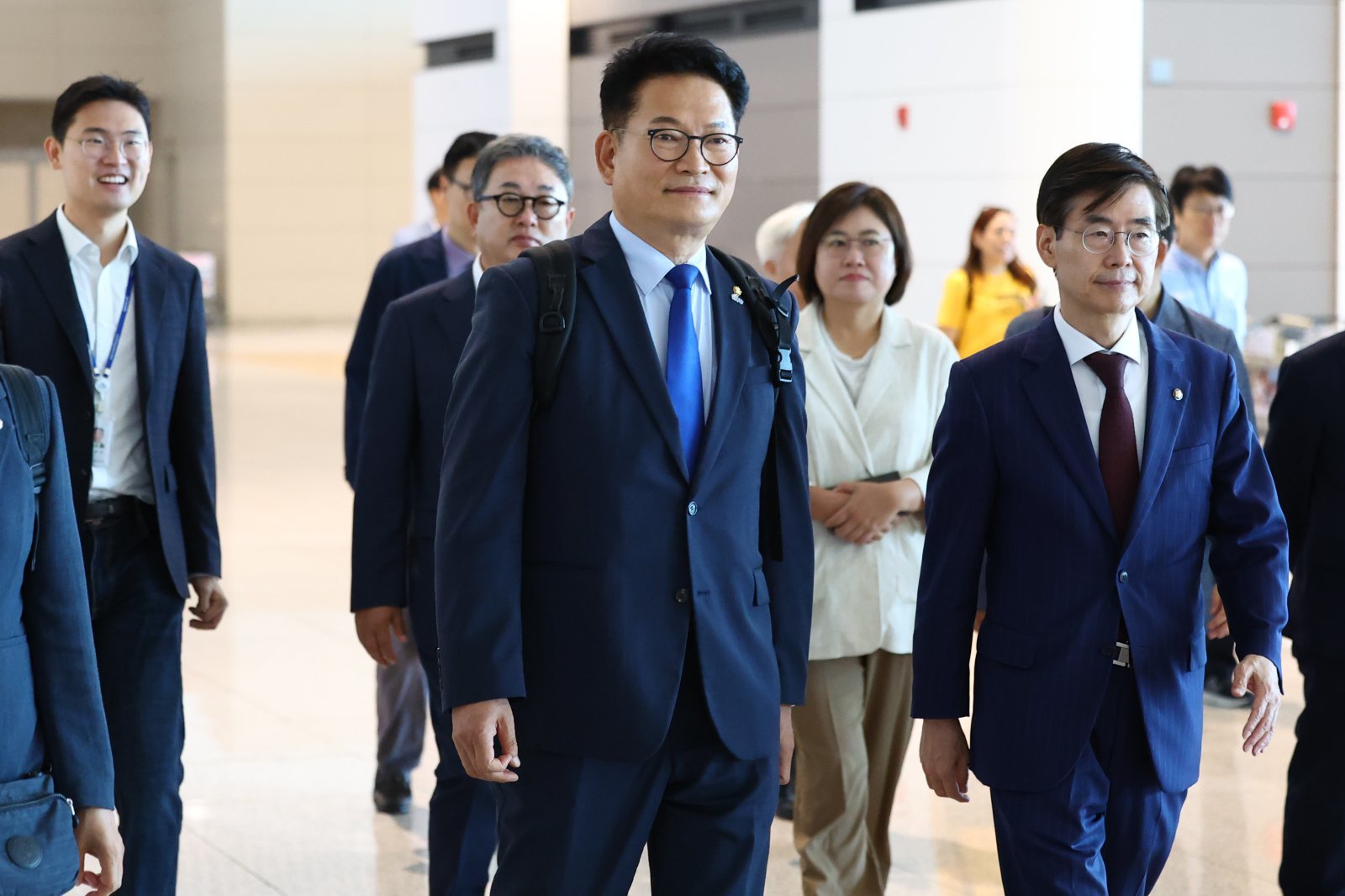
The Democratic Party's race for its next leader is intensifying, with former leader Chung Sye-kyun officially announcing his bid for re-election on the 24th. He stated, "The Lee Jae-myung administration advocates for pragmatism, but we cannot halt reform tasks for even a moment." Prime Minister Kim Min-seok and lawmaker Song Young-gil are also expected to declare their candidacies for the August 17 convention. Kim and Song are reportedly exploring an anti-Chung alliance to compete for party leadership.
This convention marks the first time a runoff voting system will be implemented. If no candidate secures a majority in the first round, the top two will proceed to a runoff. The expectation is that votes will consolidate behind one of the two leading candidates in the second round. Song Young-gil reportedly met with President Lee Jae-myung at the presidential residence to discuss this strategy. Lawmaker Park Jie-won of the Democratic Party commented on CBS's "Park Sung-tae's News Show" on the 24th, "We discussed matters related to the convention, and he mentioned a plan to create a situation where votes coalesce in a runoff, aiming for a three-way race that ultimately unifies with Prime Minister Kim Min-seok."
President Lee's discussion with Song about his candidacy is seen as a signal that the president wants to prevent Chung Sye-kyun's re-election. Former Justice Party lawmaker Park Won-seok noted on SBS's "Political Show" on the 25th, "From the president's perspective, it's safer to run on two tracks and meet at the finish line than on a single track... This makes Chung Sye-kyun seem somewhat isolated... It wouldn't be bad if Prime Minister Kim Min-seok wins, nor if Song Young-gil wins. The important thing is to win."
The Lee Jae-myung administration advocates for pragmatism, but we cannot halt reform tasks for even a moment.
President Lee expressed disappointment with the Democratic Party's performance in the local elections during his first-year press conference on the 8th. He stated, "When you are the opposition, you must pierce like a spear, but when you are the ruling party, you must be a vessel." He also offered words of support for former Prime Minister Kim Min-seok, who hinted at his party leadership bid: "The cabinet has run diligently towards a single goal in the direction I have set, without any noise, thanks to Prime Minister Kim Min-seok's outstanding leadership. Now, it is more appropriate for him to take on a different role, which led to this change."
Following this, only Prime Minister Kim was invited to a send-off event for the president's European tour, while Chung Sye-kyun was excluded. The next day, Chung made a significant remark: "The people are eternal, but the administration is short-lived." Although Chung attended the return reception from the European tour on the 18th, President Lee's expression as he shook hands with a deeply bowing Chung conveyed a sense of coldness. This series of events has fueled speculation that President Lee has expressed his disapproval of Chung's re-election.
The perception that the Democratic Party's leadership race is evolving into a "Lee-Chung showdown" stems from these developments. The president has explicitly shown a negative stance towards Chung's re-election, while Chung, rather than passively accepting this, has officially announced his candidacy, pursuing his own path. This dynamic raises two main concerns.
We discussed matters related to the convention, and he mentioned a plan to create a situation where votes coalesce in a runoff, aiming for a three-way race that ultimately unifies with Prime Minister Kim Min-seok.
First, the escalating conflict between the president and the ruling party leader in the second year of the administration could undermine the government's foundation. Disagreements between the president's goals and the party leader's objectives could hinder smooth governance. Song Young-gil has pointed out that if Chung Sye-kyun is re-elected, President Lee's lame-duck period will begin. "If the party collapses, it leads to the president's lame duck status," Song stated on KBC's "News Maker" on the 21st. "If the party leadership denies the president's words and decides to fight him head-on by running for office, what will happen to the ruling party? It's a crisis situation where national governing momentum could be completely lost."
However, some argue this is an overstatement. Democratic Party lawmaker Choi Min-hee countered on BBS's "Kim Tae-seop's Morning Journal" on the 25th, "Although presidential approval ratings have fallen in the first year, not the fourth, a lame duck situation cannot arise from approval ratings in the high 40s. ... Calling it a lame duck situation is, in itself, a false speculation."
Second, there are significant concerns about the intensification of division and conflict within the supporter base. Currently, within the Democratic Party and the broader democratic reform camp, some hardline party members and supporters are divided into factions, engaging in verbal attacks and using derogatory terms for each other. This behavior is alienating a considerable number of supporters and the general public.
From the president's perspective, it's safer to run on two tracks and meet at the finish line than on a single track... This makes Chung Sye-kyun seem somewhat isolated... It wouldn't be bad if Prime Minister Kim Min-seok wins, nor if Song Young-gil wins. The important thing is to win.
Democratic Party lawmaker Woo Won-sik lamented on CBS's "Park Sung-tae's News Show" on the 25th, "The derogatory terms used even by those who strongly support us are embarrassing for the public to hear." This is cited as one of the main reasons for the decline in the ruling party's approval ratings. President Lee Jae-myung remarked on the 19th during a briefing on his European tour results, "Approval ratings have plummeted since the election. We must take this seriously. Perhaps the biggest reason is that people are struggling to make a living and are asking, 'What are they fighting about?'"
Despite this, there appears to be no move at the party level to issue warnings or impose restrictions. It is hoped that this is not because party leaders and prominent figures outside the party view the situation through an overly simplistic, binary lens.
Amidst this situation, attention is focused on what key issues will shape the party leadership race. First, let's examine the issue of abolishing the supplementary investigation rights. Former leader Chung Sye-kyun was the first to bring up this issue. Whenever President Lee Jae-myung expressed his personal opinion, albeit conditionally, that allowing the prosecution's supplementary investigation rights in very exceptional cases would be desirable, Chung consistently argued for the complete abolition of these rights.
When you are the opposition, you must pierce like a spear, but when you are the ruling party, you must be a vessel.
DistantNews Editorial
Originally published by Hankyoreh in Korean. Translated, summarized, and contextualized by our editorial team with added local perspective. Read our editorial standards.
More Stories

From Our Blog

What Gets Lost (and Found) When News Is Translated

The Critical Role of Diaspora Media in Global News

What Travellers Should Know About Countries with Restricted Press

A Digital Nomad's Guide to Following Local News

How the Same Story Looks Different in Different Countries
