


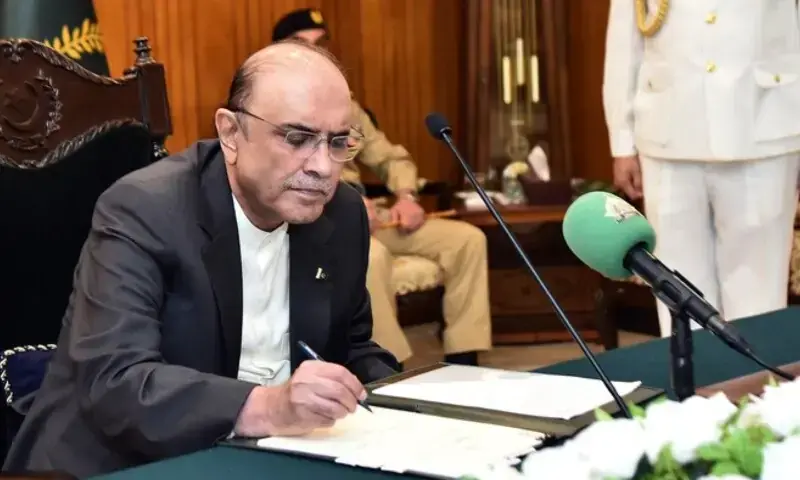
Presidential Approval Delays Hamper Judicial Appointments in Pakistan
Translated from English, summarized and contextualized by DistantNews.
At a glance
News
Sources not specified
Ongoing story
- The delay in presidential assent for judicial appointments is impacting Pakistan's superior judiciary.
- An additional judge of the Sindh High Court's term expired due to the delay, and four judges at the Peshawar High Court face a similar situation.
- Recommendations for extensions from the Judicial Commission of Pakistan are pending presidential approval.
Delays in presidential approval for judicial appointments are beginning to disrupt the functioning of Pakistan's superior courts. The term of an additional judge at the Sindh High Court (SHC) has already expired, and four additional judges at the Peshawar High Court (PHC) are facing imminent expiration of their tenures, despite recommendations for their continuation.
Justice Khalid Hussain Shahani of the SHC, appointed as an additional judge in January 2025 for a one-year term, received a six-month extension until July 29. The Judicial Commission of Pakistan (JCP) recommended a further six-month extension on July 20. However, the summary remains with the Presidency, and no formal notification has been issued, causing Justice Shahani's term to lapse. Despite this, the SHC included his name in the judge roster, anticipating the notification.
An additional judge cannot continue to hold office beyond the expiry of his tenure unless the president formally approved the extension and the Law Ministry issued the notification.
Sources within the Presidency stated that an additional judge cannot continue in office past their tenure without formal presidential approval and a Law Ministry notification. This situation echoes the case of former Islamabad High Court judge Justice Shaukat Aziz Siddiqui, whose confirmation was rejected by then-president Asif Ali Zardari in 2012, despite JCP recommendations. The Supreme Court later observed that the president's role in judicial appointments had become largely ceremonial after constitutional amendments, binding him to act on the prime minister's advice.
A similar predicament faces four additional judges at the PHC, Justice Farah Jamshed, Justice Inamullah Khan, Justice Sabitullah Khan, and Justice Aurangzeb, whose terms expire on August 4. Appointed on February 4, 2025, their initial six-month extensions were approved by the president. However, a subsequent JCP recommendation for further extensions is now awaiting presidential assent, mirroring the uncertainty surrounding Justice Shahani's position.
Following the 18th and 19th Constitutional Amendments, the president’s role in the appointment of judges had become largely ceremonial and that he was bound to act on the prime minister’s advice.
DistantNews Editorial
Originally published by Dawn in English. Translated, summarized, and contextualized by our editorial team with added local perspective. Read our editorial standards.
More Stories


From Our Blog

What Gets Lost (and Found) When News Is Translated

The Critical Role of Diaspora Media in Global News

What Travellers Should Know About Countries with Restricted Press

A Digital Nomad's Guide to Following Local News

How the Same Story Looks Different in Different Countries
