


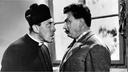
Priest vs. Communists: How 'Don Camillo' Became an Enduring Classic
Translated from Croatian, summarized and contextualized by DistantNews.
At a glance
In-depth
Sources not specified
Context piece
- The article discusses the enduring appeal of the classic film "Don Camillo," which humorously depicts the ideological conflict between a priest and a communist mayor in post-war Italy.
- It highlights the film's unique portrayal of the priest's conversations with Jesus on the cross, serving as his conscience.
- The piece explores the film's provocative nature in its time and the real-life friendship between its lead actors, Fernandel and Gino Cervi.
In a small Italian town after World War II, a stubborn priest and a newly elected communist mayor engage in an ideological war filled with humor, fistfights, and a hidden friendship. This classic film, "Don Camillo," continues to captivate audiences today.
The story is set in Brescello, a town in the Po River valley, where life is disrupted by the Communist Party's victory in local elections in 1946. Giuseppe Bottazzi, known as Peppone, becomes the mayor, much to the dismay of Don Camillo, the town's parish priest. Their conflict, both ideological and personal, forms the core of the film, showcasing a warm and humorous tale of humanity that transcends political divisions.
"Don Camillo" was particularly provocative for its time, set against the backdrop of a Italy sharply divided between the Christian Democrats, supported by the Church, and the strong Communist Party. The film's daring element was the depiction of Don Camillo's conversations with Jesus on the crucifix in his church. These dialogues served as a moral compass for the priest, with Jesus's voice offering wisdom and gentle reproach, often preventing Don Camillo from acting rashly.
Despite the on-screen rivalry, actors Fernandel and Gino Cervi, who portrayed Don Camillo and Peppone respectively, shared a strong friendship in real life, which contributed significantly to the series' success. The film, based on Giovannino Guareschi's stories, was initially considered too politically risky by many Italian directors, but French director Julien Duvivier ultimately brought it to life, balancing satire with a celebration of the Italian spirit.
DistantNews Editorial
Originally published by Večernji List in Croatian. Translated, summarized, and contextualized by our editorial team with added local perspective. Read our editorial standards.
More Stories


From Our Blog

What Gets Lost (and Found) When News Is Translated

The Critical Role of Diaspora Media in Global News

What Travellers Should Know About Countries with Restricted Press

A Digital Nomad's Guide to Following Local News

How the Same Story Looks Different in Different Countries
