


Quarry Artisans: Custodians of a Fading Purépecha Legacy
Translated from Spanish, summarized and contextualized by DistantNews.
At a glance
In-depth
Sources not specified
Context piece
- Artisans in Tzintzuntzan, Mexico, are struggling to preserve the ancient craft of quarry stone carving as sales decline and younger generations find the work unprofitable.
- José Saúl Barriga Salmerón is leading a project called Cantera Morelia to create custom sculptures and architectural designs, aiming to keep the tradition alive.
- Historically, foreign tourists were major buyers, but their numbers have decreased, leading many workshops to close.
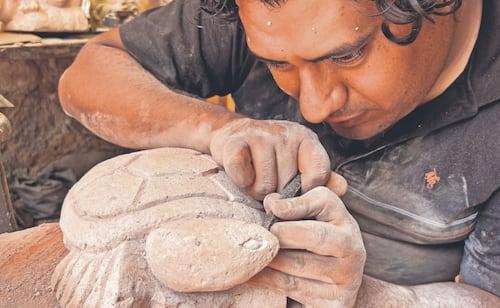
In the quiet community of Las Camelinas, Tzintzuntzan, Mexico, the ancient art of quarry stone carving is facing a slow decline. Artisans, once the custodians of a rich Purépecha legacy, are finding it increasingly difficult to sustain their craft as sales dwindle and the profession becomes less profitable for younger generations.
In this part, many years ago, there were many workshops where this work [carving and working quarry stone] was done, but as you can see, the workshops are disappearing. Some relocated to other areas further ahead, but many have also disappeared.
José Saúl Barriga Salmerón, a stone artisan, is determined to keep this tradition alive. In 2020, he launched the Cantera Morelia project, which focuses on creating personalized sculptures and architectural designs. Working from a small, generations-old workshop, Barriga Salmerón laments the disappearance of many similar artisan spaces, which have either relocated or been repurposed into simple rooms or vacant lots.
He recalls a time when the road connecting his village to the popular tourist destination of Pátzcuaro was bustling with foreign visitors who were the primary customers for quarry stone sculptures. "Foreigners used to arrive and leave with trucks full," he told EL UNIVERSAL. "They would empty workshops, but little by little, sales decreased, and for those reasons, many workshops had to close."
Foreigners used to arrive and leave with trucks full. They would empty workshops, but little by little, sales decreased, and for those reasons, many workshops had to close.
Barriga Salmerón, who also holds a degree in mechanical engineering, sees his family's workshop not just as a workspace but as a sacred space. It's where his childhood unfolded, and where the echoes of his ancestors resonate powerfully. This deep connection fuels his commitment to preserving the tradition, even as the economic instability of the craft discourages new artisans from entering the field.
And since [quarry stone carving] is not a job that generates economic stability, the new generations...
DistantNews Editorial
Originally published by El Universal in Spanish. Translated, summarized, and contextualized by our editorial team with added local perspective. Read our editorial standards.
More Stories


From Our Blog

What Press Freedom Means for the News You Read

What Gets Lost (and Found) When News Is Translated

The Critical Role of Diaspora Media in Global News

What Travellers Should Know About Countries with Restricted Press

A Digital Nomad's Guide to Following Local News
