


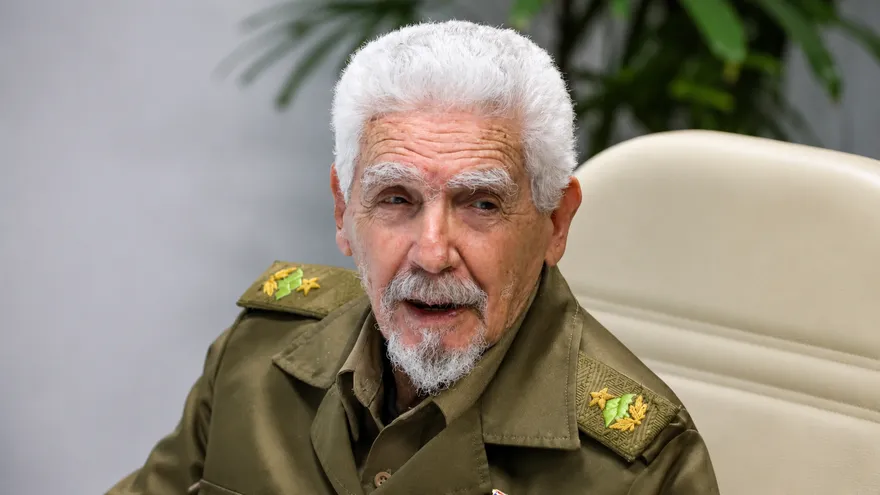
Ramiro Valdés, Cuban Revolution figure and intelligence founder, dies at 94
Translated from Spanish, summarized and contextualized by DistantNews.
At a glance
News
Named sources
Outcome reported
- Ramiro Valdés, a historic commander of the Cuban Revolution and founder of the island's intelligence services, has died at age 94.
- He was a key figure in the revolutionary process led by Fidel Castro and played a crucial role in Cuba's intelligence and state security apparatus.
- Valdés participated in the 1953 Moncada barracks assault and later became second-in-command to Che Guevara during the Sierra Maestra campaign.
Ramiro Valdés, a pivotal commander in the Cuban Revolution and a founder of the island's intelligence services, has died at the age of 94, as announced by Cuban President Miguel Díaz-Canel. Valdés stood as one of the most influential and controversial figures of the revolutionary process initiated by Fidel Castro, and was among the last historical leaders actively involved in Cuba's power structure.
As a Commander of the Revolution, former Minister of the Interior, deputy prime minister, and founder of the feared G2 intelligence service, Valdés was instrumental during the most tense periods of confrontation between Cuba and the United States. Detractors viewed him as ruthless, but Valdés himself acknowledged the effectiveness of the intelligence mechanisms developed after the revolution's triumph in a 2018 interview. "There was no one moving that security didn't know about, and that allowed us to penetrate counter-revolutionary organizations," he stated.
Michael Shifter, an analyst at the Inter-American Dialogue think tank, described Valdés as a fundamental piece in the years following 1959, a period when the revolutionary government faced armed opposition movements. Born on April 28, 1932, into a humble family in what is now Artemisa province, Ramiro Valdés was among the first to join Fidel Castro's movement. At 21, he participated in the assault on the Moncada barracks on July 26, 1953, an event considered the symbolic beginning of the Cuban Revolution. Following the action's failure, he was imprisoned with Fidel and Raúl Castro.
There was no one moving that security didn't know about, and that allowed us to penetrate counter-revolutionary organizations.
After his release, he traveled to Mexico and joined the expedition aboard the yacht Granma, which landed in Cuba in 1956 to commence the guerrilla struggle. During the Sierra Maestra campaign, Valdés served as the second-in-command of the column led by Ernesto "Che" Guevara, with whom he forged a close political and military relationship. He often recalled the Argentine revolutionary as one of the most influential people in his life. "He was very strict, especially with those closest to him, he was uncompromising, but also very fraternal," Valdés said of Che.
Following the Revolution's triumph in 1959, Valdés held several significant positions within the new government. He served as Minister of the Interior from 1961 to 1968 and again from 1979 to 1985, periods during which he solidified the state's intelligence and security organizations. He was also a founding member of the Communist Party of Cuba (PCC) and a member of the powerful Political Bureau since 1975. Although he stepped back from frontline politics in 1986 to make way for new generations, he returned to the core of power in 2008 under Raúl Castro's administration, who appointed him Minister of Communications. From this role, he oversaw aspects of the internet's expansion in the country.
He was very strict, especially with those closest to him, he was uncompromising, but also very fraternal.
DistantNews Editorial
Originally published by TVN Panamá in Spanish. Translated, summarized, and contextualized by our editorial team with added local perspective. Read our editorial standards.
More Stories
From Our Blog

What Gets Lost (and Found) When News Is Translated

The Critical Role of Diaspora Media in Global News

What Travellers Should Know About Countries with Restricted Press

A Digital Nomad's Guide to Following Local News

How the Same Story Looks Different in Different Countries
