



Rare 1,800-Year-Old Roman Mosaic May Preserve a Wealthy Man’s Tribute to His Pet Cat and Dog
Translated from English and summarized by DistantNews. Read the original for the full story.
At a glance
In-depth
Named sources
Context piece
- Archaeologists uncovered a richly colored mosaic at the ancient city of Adramytteion on Türkiye’s Aegean coast, in a villa dated to the late second or third century AD.
- Two animal panels bear names: a leaping dog marked “Ocean” and a pale cat that researchers associate with “Emerald.”
- The mosaic’s animals, mythological figures and costly materials reflect the artistic display and social status associated with wealthy Roman villas.
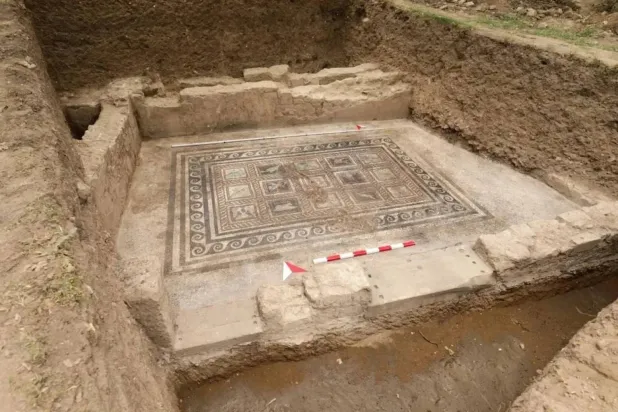
A richly colored Roman mosaic may preserve a wealthy man’s tribute to his beloved dog and cat. Archaeologists found the 1,800-year-old artwork in the reception area of a villa at the ancient city of Adramytteion on Türkiye’s Aegean coast.
The mosaic measures about 5 metres by 3.6 metres and occupies the centre of the villa’s main North Hall. A forthcoming study in the Journal of Mosaic Research says visitors entering the reception room would have encountered the artwork immediately. A pale cat appears on the left, while a running or leaping dog appears on the right.
The dog panel carries the Greek letters “ΩΚΕΑΝΟΣ,” meaning “Ocean.” Researchers believe the cat may have been named “Emerald,” although the article presents that identification as a possibility. These are the only animal figures in the mosaic with names.
rich polychrome palette
The artwork contains 15 panels arranged in three rows. They depict birds, fish, felines, domesticated and wild animals, and mythological figures including Medusa and Pegasus. Its artists used red, orange, black, white, blue, green, yellow and burgundy tesserae in what researchers describe as a rich polychrome palette.
Such elaborate mosaics, made with expensive materials including marble and colored glass, often appeared in entryways, reception rooms and dining areas. Wealthy Romans used them to display artistic taste and social standing. Researchers say the imagery was especially common in North Africa. They suspect the dog’s name may relate to Adramytteion’s history as a harbor city, while the cat’s possible name may point to a connection with Roman Egypt, where emeralds were mined in antiquity.
The figural repertoire varied, combining animal imagery, particularly birds, together with emblematic and mythological elements, including a winged horse, a pygmy figure, a Medusa head, and representations of domesticated and wild animals, as well as a fish.
About this summary
Originally published by Asharq Al-Awsat in English. Translated, summarized, and contextualized automatically by DistantNews, with a note on how the source frames the story. Not individually reviewed before publishing. How this works.
More Stories



From Our Blog

News in Translation: What Gets Lost, and How We Keep the Framing

Diaspora Media: How Communities Follow News From Home

Traveling Where the Press Is Not Free: How to Read the News There

The Digital Nomad's Guide to Local News

The Same Story, Different Countries: How Coverage Changes at the Border
