


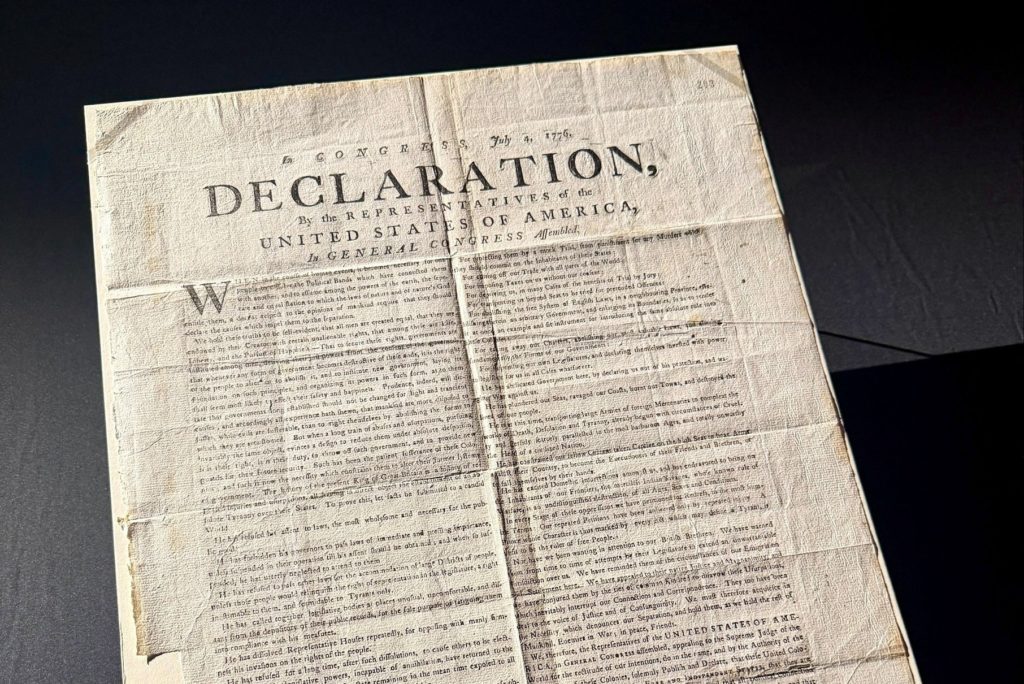
Rare copy of Declaration of Independence found by UK National Archives in papers of captured U.S. privateer ship
Summarized and contextualized by DistantNews.
At a glance
News
Named sources
New plan
- A rare early copy of the U.S. Declaration of Independence was discovered at Britain's National Archives.
- The document, printed in Exeter, New Hampshire, in July 1776, was found among papers from a captured American privateer ship.
- It is one of 11 known copies of the Exeter printing and the only one found outside the United States.
A volunteer at Britain's National Archives has discovered a rare early copy of the U.S. Declaration of Independence. Michael Scurr found the document last May while cataloging papers from an 18th-century Royal Navy captain. The declaration was attached to a report about the capture of the American privateer Dalton in December 1776.
Researchers confirmed the document as a rare copy printed in Exeter, New Hampshire, between July 16-19, 1776. This printing was intended to spread news of the colonies' severed ties with Britain. It is one of only 11 known copies of the Exeter printing and the sole example located outside the United States. The National Archives unveiled the find ahead of the 250th anniversary of American independence.
I thought, oh, right, OK, this is definitely a Declaration of Independence. How exciting is this?
The document's significance extends beyond its age. Amanda Bevan, head of the National Archives' project cataloging Royal Navy captain correspondence during the American Revolution, highlighted its capture from a ship operating under the Continental Congress. She believes the captain would have read the declaration aloud to his crew, reinforcing the ideals for which they were fighting.
"They know why they're fighting, but this puts it in a language which makes it greater than them," Bevan stated. "They're not fighting because they're aggrieved in particular. They're fighting for an ideal. And I think that just to find the declaration in a theater of war where people are committing themselves to fight for their country on the wide ocean is really something special."
They know why they're fighting, but this puts it in a language which makes it greater than them. They're not fighting because they're aggrieved in particular. They're fighting for an ideal. And I think that just to find the declaration in a theater of war where people are committing themselves to fight for their country on the wide ocean is really something special.
DistantNews Editorial
Originally published by PBS NewsHour. Summarized and contextualized by our editorial team with added local perspective. Read our editorial standards.
More Stories



From Our Blog

How the Same Story Looks Different in Different Countries

What Gets Lost (and Found) When News Is Translated

The Critical Role of Diaspora Media in Global News

What Travellers Should Know About Countries with Restricted Press

A Digital Nomad's Guide to Following Local News
