


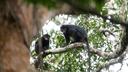
Rare monkey with striking orange lips discovered in Congo rainforests
Translated from Croatian, summarized and contextualized by DistantNews.
At a glance
News
Sources not specified
New plan
- Scientists have confirmed a new species of monkey, the Colobus congoensis, in the Democratic Republic of Congo after nearly two decades of research.
- The monkey, distinguished by its black fur and striking pinkish-orange lips, lives high in the trees and is difficult to spot.
- Conservationists hope the official recognition of this rare species will lead to better legal protection, as it is hunted for meat.
After nearly 20 years of searching, scientists have confirmed the existence of a previously unknown species of monkey in the rainforests of the Democratic Republic of Congo. The animal, characterized by its black fur, dark face, and distinctive pinkish-orange lips, is exceptionally difficult to spot due to its life high in the tree canopies, according to the BBC.
Conservationists first noticed the unusual primate in 2008 in Lomami National Park, but only managed to capture a blurry photograph at the time. A decade later, a new sighting prompted an international research team to begin a systematic study of the species. Through a combination of field observations, sound recordings, photography, and genetic analysis, it was confirmed to be a new species, named Colobus congoensis.
This marks only the fifth new species of African monkey discovered in the last 75 years. Although local inhabitants have long known the animal by the name Likweli, scientific research has only now proven it is genetically distinct enough to be classified as a separate species. Researchers note that the monkeys are very shy and spend most of their time high in the dense tropical forests.
During the research, they spoke with residents in 52 villages near the monkeys' habitat, but only inhabitants of eight villages had ever seen these animals. The new species belongs to the colobus group, African monkeys that lack thumbs and primarily feed on leaves. Scientists believe they play an important role in the forest ecosystem by aiding in seed dispersal and germination.
It is also hypothesized that their brightly colored lips serve for mutual recognition or attracting mates. The monkeys communicate with a characteristic deep roar that is often heard, though they are rarely seen. As they are hunted for meat, researchers hope that the official recognition of the new species will also enable better legal protection. The next step will be to assess the population size and study their behavior in more detail.
DistantNews Editorial
Originally published by Večernji List in Croatian. Translated, summarized, and contextualized by our editorial team with added local perspective. Read our editorial standards.
More Stories



From Our Blog

What Gets Lost (and Found) When News Is Translated

The Critical Role of Diaspora Media in Global News

What Travellers Should Know About Countries with Restricted Press

A Digital Nomad's Guide to Following Local News

How the Same Story Looks Different in Different Countries
