


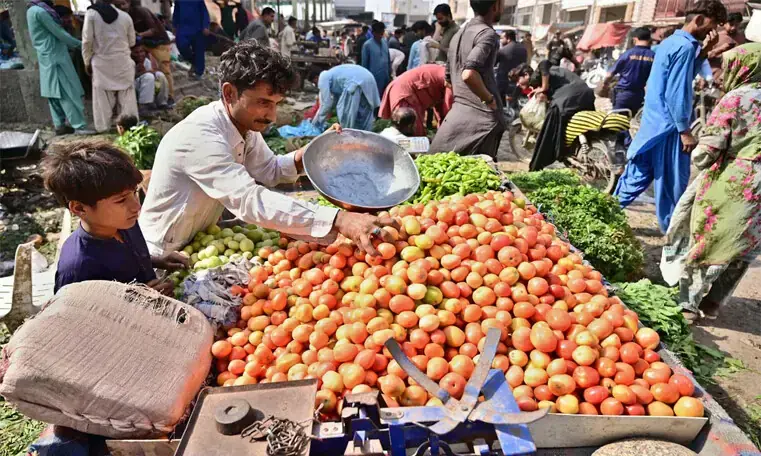
Rebounding inflation, fiscal pressures threaten recovery
Summarized and contextualized by DistantNews.
At a glance
News
Named sources
Context piece
- Pakistan's economic recovery, which began in 2025, is stalling due to geopolitical issues, causing rising inflation and reduced monetary freedom.
- A think tank reports that debt servicing and defense consume 94% of federal revenue, leaving little for essential services.
- The report criticizes the government's reliance on borrowing and suggests a policy shift towards economic freedom, away from IMF-required stabilization.
Pakistan's fragile economic recovery, initiated in 2025, is faltering under the weight of geopolitical instability, leading to a resurgence of inflation and diminishing monetary freedom for individuals and businesses. The Policy Research Institute of Market Economy (Prime), a private think tank, highlighted in its July 2026 report that consumer price inflation re-entered double digits between April and June, reaching 10.9-11.7%, with the sensitive price index climbing to 12.8% by June. This economic pressure significantly curtails the financial autonomy of citizens and firms in an economy where approximately 80% of the workforce operates informally.
The macroeconomic recovery that began in 2025 is stalling due to geopolitical obstacles. CPI inflation re-entered double digits at 10.9-11.7pc between April and June, with the SPI climbing to 12.8pc by June, reducing the monetary freedom of individuals and firms.
Compounding these issues, Prime's analysis reveals that debt servicing and defense expenditures consume a staggering 94% of net federal revenue. This leaves a mere six percent for crucial sectors such as health, education, infrastructure, and social protection, severely constraining the government's ability to fund essential public services. The report also points to significant tax disparities, noting that a salaried individual earning Rs5 million faces an effective tax rate of 33.29%, while a shopkeeper with the same income pays only 0.5% under simpler tax schemes, a gap the Budget 2026-27 failed to address.
Debt servicing and defence consumed 94pc of net federal revenue, while in recent years defence spending had increased further, leaving just six per cent of revenue for health, education, infrastructure, social protection and all other essential government functions.
Prime advocates for a fundamental policy shift, urging a move away from the reactive "stabilization" measures often required by the International Monetary Fund (IMF). Instead, the think tank calls for a resilience-driven framework that prioritizes economic freedom, defined as the inherent ability of individuals to control their property and labor. Citing the Heritage Foundation's Index of Economic Freedom, where Pakistan scored 48.9 in the "Repressed" category, Prime argues that even seemingly favorable scores on indicators like government spending and tax burden mask a more challenging reality. The report suggests that Pakistan is neither a lean nor a low-tax state, despite some index scores implying otherwise.
Several scores conceal rather than reveal reality: Government Spending (88.5) and Tax Burden (78.2) suggest a lean, low-tax state; Pakistan is neither.
DistantNews Editorial
Originally published by Dawn. Summarized and contextualized by our editorial team with added local perspective. Read our editorial standards.
More Stories

From Our Blog

What Gets Lost (and Found) When News Is Translated

The Critical Role of Diaspora Media in Global News

What Travellers Should Know About Countries with Restricted Press

A Digital Nomad's Guide to Following Local News

How the Same Story Looks Different in Different Countries
