


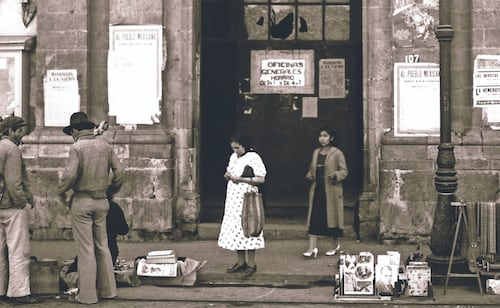
Reflecting on 100 years of Mexico's Cristero War
Translated from Spanish, summarized and contextualized by DistantNews.
At a glance
News
Named sources
Context piece
- Mexico's National Institute of Historical Studies on the Revolutions is hosting virtual discussions marking the 100th anniversary of the Cristero War.
- The conflict, also known as La Cristiada, began July 31, 1926, following the enforcement of the Calles Law, which severely restricted Catholic Church activities.
- Discussions explore the historical relationship between church and state in Mexico, tracing its roots to the Spanish conquest and its evolution through independence and subsequent reforms.
Mexico is commemorating the 100th anniversary of the Cristero War, or La Cristiada, with a series of virtual discussions organized by the National Institute of Historical Studies on the Revolutions of Mexico (INEHRM).
The conflict erupted on July 31, 1926, after the implementation of the Calles Law, which drastically curtailed the activities of the Catholic Church. The initial virtual session focused on "Political and Ecclesiastical Power: Church and State in the Mexican 19th Century," examining the historical relationship between these institutions.
Researcher Cristina Gómez Álvarez explained that understanding La Cristiada requires grasping the long-standing connection between the Church and the State, which originated during the Spanish conquest. In colonial times, the Church in Latin America was subordinate to the Spanish crown, with monarchs appointing bishops, managing church resources, and defining jurisdictions.
This relationship begins when the Spaniards arrive to conquer what would later be New Spain; the church in Latin America was born subordinate to the Spanish kings.
Investigator Reveriano Sierra noted that while the 1917 Constitution outlined limits on the Church's role, a practical coexistence persisted. The Calles Law aimed to formalize this relationship, but the Church hierarchy responded by suspending Catholic worship and abandoning parishes. This action ultimately fueled popular mobilization and led to the armed conflict.
Historian Carlos Martínez Assad further detailed that the war began in August 1926 in Zacatecas when peasants attempted to free a local priest. The conflict rapidly spread, involving thousands and evolving through various stages until the cessation of hostilities.
There was a coexistence between the Church and the State, so the Calles Law sought to regulate that relationship. The high ecclesiastical hierarchy responded with the suspension of Catholic worship in the temples, with the abandonment of the parishes by the priests, and that finally led to popular mobilization and the armed conflict.
DistantNews Editorial
Originally published by El Universal in Spanish. Translated, summarized, and contextualized by our editorial team with added local perspective. Read our editorial standards.
More Stories
From Our Blog

What Press Freedom Means for the News You Read

What Gets Lost (and Found) When News Is Translated

The Critical Role of Diaspora Media in Global News

What Travellers Should Know About Countries with Restricted Press

A Digital Nomad's Guide to Following Local News
