


Rescuers Continue Grim Search for Survivors of Nepal Floods
Translated from English and summarized by DistantNews. Read the original for the full story.
At a glance
Newswire
From a news agency
Ongoing story
- Emergency teams continued searching debris and blocked hydropower tunnels in Nepal after a flood disaster killed at least 1,325 people in Nepal and China.
- The rescue of two hydropower workers alive after nine days renewed efforts to find hundreds of missing workers, while at least 12 hydropower projects were destroyed.
- Nepal has buried about 1,030 unidentified bodies in mass graves after collecting DNA samples, and the government promised safer accommodation for displaced people.
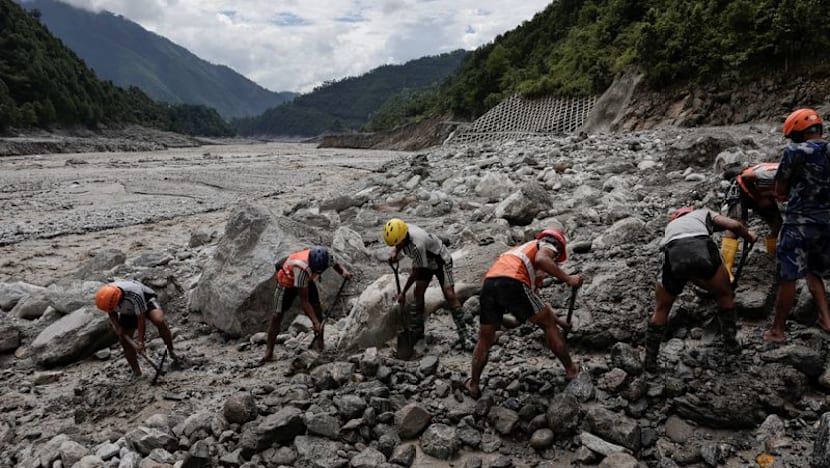
The rescue of two hydropower workers after nine days trapped in mud has given Nepal’s emergency teams new impetus, even as the search for survivors remains grim. On Sept. 5, rescuers dug through debris at the Trishuli 3A tunnel and other sites after a tsunami-like wall of water and mud swept across the China-Nepal border.
We have been working since morning on search and rescue operations
Nepal’s disaster agency said 1,294 bodies had been recovered and 5,053 people remained missing. Chinese state media reported 31 deaths and 531 missing people, bringing the combined toll to 1,325 dead and 5,584 missing.
“We have been working since morning on search and rescue operations,” Nepal Army spokesman Raja Ram Basnet told AFP. “Work is also underway at the tunnels. We don’t have an update yet, but the work goes on.”
Work is also underway at the tunnels. We don’t have an update yet, but the work goes on.
The two men pulled from the Trishuli 3A tunnel on Sept. 4 were covered in mud and taken to hospital in stable condition. Rescuers described their survival as a “miracle.” The government initially believed more than 100 workers could still be alive inside several tunnels. Experts from India, China, Australia and South Korea joined Nepali teams searching the blocked passages, while at least 12 hydropower projects lay destroyed by the floods.
safe and comfortable accommodation
With morgues overflowing, Nepal Police said around 1,030 bodies had been buried in mass graves after DNA samples were taken for future identification. Prime Minister Balendra Shah promised “safe and comfortable accommodation” for thousands of displaced people living in temporary camps. “We know that staying there (camps) is not easy for you,” he wrote in an emotional social media post. “(But) we will once again create an environment where you can dream about and build your future.”
We know that staying there (camps) is not easy for you. (But) we will once again create an environment where you can dream about and build your future.
About this summary
Originally published by The Straits Times in English. Translated, summarized, and contextualized automatically by DistantNews, with a note on how the source frames the story. Not individually reviewed before publishing. How this works.
More Stories

From Our Blog

News in Translation: What Gets Lost, and How We Keep the Framing

Diaspora Media: How Communities Follow News From Home

Traveling Where the Press Is Not Free: How to Read the News There

The Digital Nomad's Guide to Local News

The Same Story, Different Countries: How Coverage Changes at the Border
