


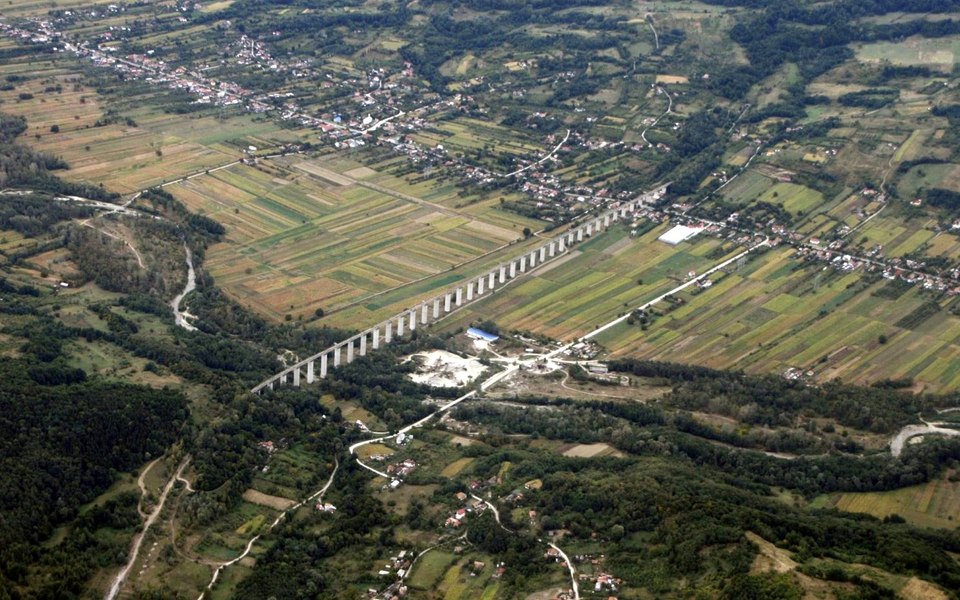
Romania's longest viaduct, abandoned for decades, set to be surpassed by new motorway structures
Translated from Romanian, summarized and contextualized by DistantNews.
At a glance
News
Sources not specified
Ongoing story
- Romania's longest viaduct, Topolog, built in the 1980s, has remained unused for over three decades.
- Two new viaducts on the Transylvania Motorway (A3) in Topa Mică and Suplacu de Barcău will surpass Topolog's length.
- Construction on the new viaducts is underway, with completion expected in 2026, potentially setting new infrastructure records.
Romania's Topolog Viaduct, a 1.35-kilometer structure built in the 1980s, stands as a testament to abandoned infrastructure, having never been used for its intended rail transport purpose. For over three decades, it has remained a silent monument, its record as the country's longest viaduct poised to be broken.
Two new viaducts on the Transylvania Motorway (A3) are set to eclipse the Topolog Viaduct's length. The Topa Mică viaduct, spanning over two kilometers, and the Suplacu de Barcău viaduct, measuring 1.8 kilometers, are under construction. The Suplacu de Barcău viaduct, part of the Târgu Mureș to Hungarian border section of the A3, began construction in 2004. Work on this section, including the viaduct, reached over 50% completion before being suspended in 2013, with the viaduct itself at 80% complete. Construction resumed in early 2024, with an expected completion date of 2026.
The Nădășelu–Poarta Sălajului segment of the A3, connecting Cluj and Oradea, also features the Topa Mică viaduct and the approximately 1.2-kilometer Nădășelu viaduct. These are slated for completion by December 2026. The construction of these new viaducts, particularly Topa Mică, involves complex engineering solutions due to unstable clay soil, requiring deep bored piles and massive concrete structures. If completed on schedule, the Topa Mică viaduct's construction in under two years would represent a significant infrastructure achievement.
DistantNews Editorial
Originally published by Adevărul in Romanian. Translated, summarized, and contextualized by our editorial team with added local perspective. Read our editorial standards.
More Stories
From Our Blog

What Gets Lost (and Found) When News Is Translated

The Critical Role of Diaspora Media in Global News

What Travellers Should Know About Countries with Restricted Press

A Digital Nomad's Guide to Following Local News

How the Same Story Looks Different in Different Countries
