

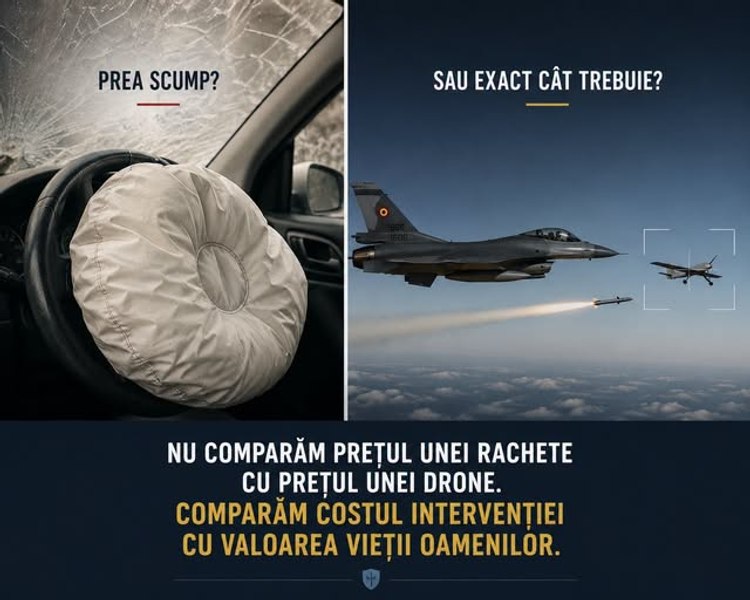

Romanian F-16 pilot explains how drones are shot down: why it sometimes takes longer
Translated from Romanian, summarized and contextualized by DistantNews.
At a glance
News
Named sources
Context piece
- A Romanian F-16 pilot explained the operational conditions required to intercept and neutralize small aerial targets like drones.
- The pilot emphasized that while systems weren't initially designed for such threats, pilots train extensively to adapt and improve effectiveness.
- He noted that the time required for interception can vary significantly, from minutes to over an hour, stressing that efficiency, not just speed, is paramount.
A Romanian F-16 pilot, commander of the Air Police detachment in Lithuania, has shed light on the complexities involved in intercepting and neutralizing drones. His explanation comes in the wake of news that Romanian forces successfully downed a second drone in Romanian airspace, a feat that filled the detachment with pride.
We just received news from home that makes us very proud of the profession we have. Our colleagues have shot down another target in Romania's airspace. Our training and dedication are paying off. Congratulations to you!
The pilot addressed public inquiries regarding the time it takes to engage such aerial objects. He explained that the first crucial step involves detecting and tracking the target with the aircraft's radar. "Our systems were not initially built to combat such enemies, but much more powerful and lethal ones," he stated, highlighting the need for continuous training and adaptation of techniques, tactics, and procedures to enhance effectiveness against smaller, less conventional threats.
Our systems were not initially built to combat such enemies, but much more powerful and lethal ones. That's why we train intensively, we change and adapt techniques, tactics, and procedures so that we become much more effective.
He further elaborated that Romanian pilots regularly conduct exercises simulating these scenarios, both domestically and during international missions. "Here in Lithuania, and at home, we have flown a lot, simulating the conditions for engaging such a target, and as you can see, we ultimately achieve the expected results," he said, referencing the successful interceptions.
Sometimes it takes us 33 minutes, like here. Other times it takes us an hour and 20 minutes, like yesterday. Other times it only takes a few minutes to engage this target.
The commander also pointed out that the time required for engagement can vary considerably. "Sometimes it takes us 33 minutes, like here. Other times it takes us an hour and 20 minutes, like yesterday. Sometimes it only takes a few minutes to engage this target." He stressed that in their profession, "fast does not necessarily mean efficient." The pilot urged the public to trust the military personnel ensuring airspace security, assuring them that they would do their utmost to fulfill their mission while keeping citizens safe on the ground.
In our profession, fast does not necessarily mean efficient. Please, trust us that we will do our best to fulfill our mission while keeping you on the ground safe. Thank you!
DistantNews Editorial
Originally published by Adevărul in Romanian. Translated, summarized, and contextualized by our editorial team with added local perspective. Read our editorial standards.
More Stories

From Our Blog

What Gets Lost (and Found) When News Is Translated

The Critical Role of Diaspora Media in Global News

What Travellers Should Know About Countries with Restricted Press

A Digital Nomad's Guide to Following Local News

How the Same Story Looks Different in Different Countries
