


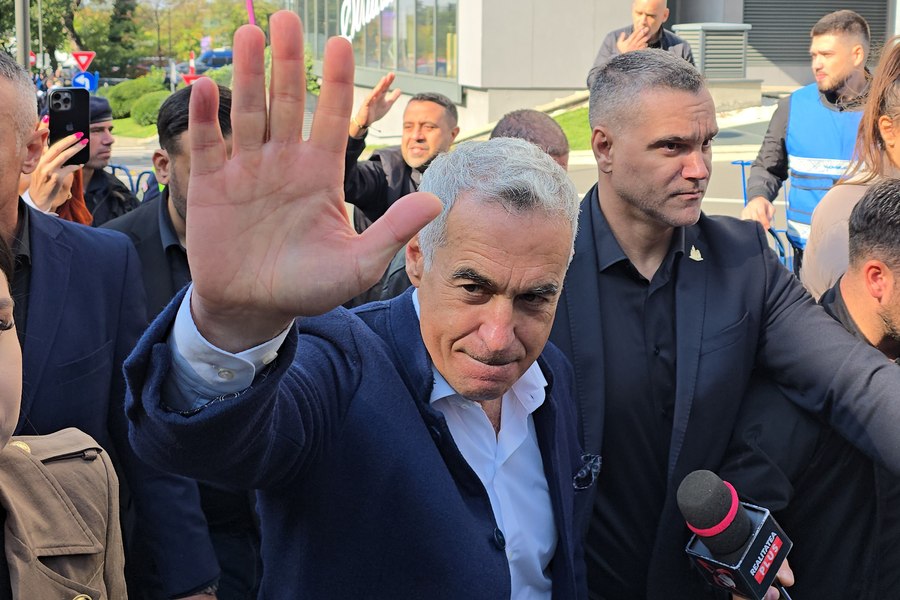
Romanian Politician Accuses PM of "Anti-Romanianism," Links Abortions to Elections
Translated from Romanian, summarized and contextualized by DistantNews.
At a glance
News
Sources not specified
Context piece
- Călin Georgescu, a former presidential candidate, has sharply criticized Romanian Prime Minister Ilie Bolojan, labeling him the "definition of anti-Romanianism."
- Georgescu accused Bolojan of favoring foreign companies, selling off national assets, and harming the Romanian economy.
- He also extended his criticism to President Nicușor Dan and other political figures, linking current political events to historical events and controversial theories about abortions.
Călin Georgescu, who previously ran for president, has launched a scathing attack on the current Romanian Prime Minister Ilie Bolojan, declaring him the "definition of anti-Romanianism" in a recent interview. Georgescu asserted that if the word "anti-Romanianism" were not in the dictionary, Bolojan would embody its meaning.
The definition of anti-Romanianism is Ilie Bolojan. That is, if you can't find something in the dictionary that means anti-Romanianism, it is Ilie Bolojan.
During the interview on Realitatea Plus, Georgescu accused Bolojan of prioritizing foreign companies and initiating the "sale of assets belonging to the Romanian people." He further claimed that Bolojan's actions have "ruined the Romanian economy." Georgescu also directed criticism towards President Nicușor Dan, holding him responsible for the current political and economic situation due to his appointment of Bolojan as prime minister. He dismissed other potential prime ministerial candidates, Eugen Tomac and Adrian Veștea, as being part of the same political establishment.
Who appointed him? Nicușor Dan. So Nicușor Dan is directly responsible for the disaster that exists today.
Georgescu delved into controversial historical theories, suggesting a connection between Romania's past and recent political events. He referred to the 1989 events as a "coup d'état" rather than a revolution, claiming that those who died were "killed" to bring the current powers to office. He then controversially linked the number of abortions in Romania over the decades to a "genocide," stating that over 20 million "souls" have been lost. Georgescu suggested that these abortions, and the deaths in 1989, have led to divine retribution, which he believes is manifesting in the current political climate and the "second coup d'état" of December 6, 2024.
Bolojan is just the anti-Romanian pattern. The other two who followed are the same.
Furthermore, Georgescu criticized the prevailing economic model in Romania, deeming it "totally wrong." He argued that the governments proposed in recent weeks have continued this flawed economic approach. His remarks reflect a deep dissatisfaction with the country's political and economic direction, framed through a lens of nationalistic grievance and historical revisionism.
To clarify the situation today very well, I would like to go back to December 1989, namely to the coup d'état. Whoever says it was a revolution either knows nothing or was bought. It was a precise coup d'état, in which people were killed, especially young people.
DistantNews Editorial
Originally published by Adevărul in Romanian. Translated, summarized, and contextualized by our editorial team with added local perspective. Read our editorial standards.
More Stories
From Our Blog

What Gets Lost (and Found) When News Is Translated

The Critical Role of Diaspora Media in Global News

What Travellers Should Know About Countries with Restricted Press

A Digital Nomad's Guide to Following Local News

How the Same Story Looks Different in Different Countries
