

Rubio reassures UAE on security, discusses Iran deal
Translated from English, summarized and contextualized by DistantNews.
At a glance
News
Named sources
New plan
- U.S. Secretary of State Marco Rubio met with UAE President Mohamed bin Zayed to discuss the U.S.-Iran deal and reaffirm security commitments.
- Rubio sought to reassure allies concerned about the deal's failure to address Iran's missile program.
- The visit included discussions on the Strait of Hormuz and regional stability, with Rubio emphasizing international law regarding waterway tolls.
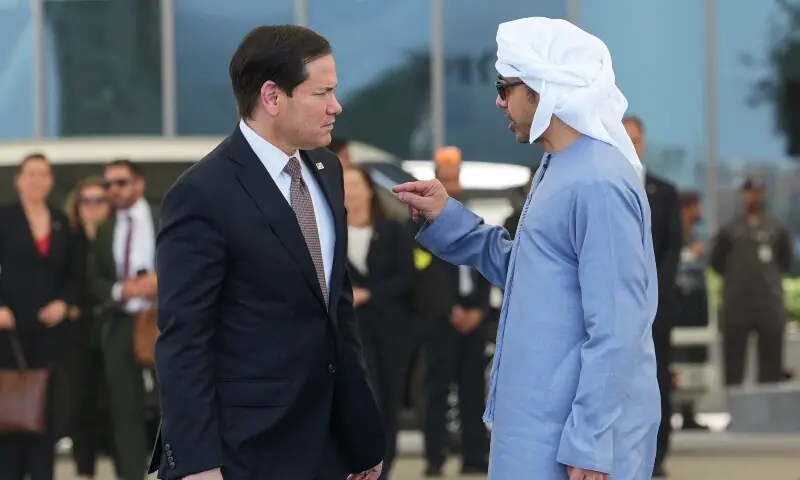
U.S. Secretary of State Marco Rubio met with UAE President Mohamed bin Zayed on Wednesday, renewing Washington's commitment to the country's security amid a tour of the Gulf. Rubio aimed to reassure close U.S. allies, who had been targeted by Iranian missiles during the Middle East war, about a memorandum of understanding with Tehran. Allies remain concerned that the deal does not adequately address Iran's long-standing missile program, although Iran contends it targeted U.S. bases and assets and has not accepted responsibility for all attacks.
They discussed President Trump’s memorandum of understanding with Iran, efforts to secure full and safe transit through the Strait of Hormuz, and the importance of peace and stability in the region.
According to spokesperson Tommy Pigott, discussions covered President Trump's memorandum of understanding with Iran, efforts to ensure safe transit through the Strait of Hormuz, and the importance of regional peace and stability. Pigott also stated that Rubio thanked the UAE for their leadership and support, praised their resilience against Iranian attacks, and reaffirmed the U.S. commitment to the Emirates' security. Rubio arrived in Abu Dhabi on Tuesday and held closed-door talks with Sheikh Mohamed before traveling to Kuwait and then Bahrain for a Gulf Cooperation Council meeting.
They thanked the UAE for their leadership and unparalleled support, praised their courage and resilience in the face of Iran’s attacks, and reaffirmed the US commitment to the security of the Emirates
Rubio insisted that no country can impose tolls on the Strait of Hormuz, an international waterway, citing existing international law. This statement followed remarks by Oman and Iran, which border the waterway, about considering charging "costs" for ships. Rubio held a working lunch with UAE President Sheikh Mohammed bin Zayed Al Nahyan and other senior officials, including National Security Adviser Sheikh Tahnoun bin Zayed Al Nahyan and Foreign Minister Sheikh Abdullah bin Zayed Al Nahyan.
It’s an international waterway. No country is allowed to charge tolls or fees on an international waterway. That’s existing international law.
When asked about allies' disquiet with the accord, Rubio told reporters that it "most certainly will come up in these discussions." He added that issues not covered by the memorandum of understanding would also be discussed. U.S. Vice President JD Vance had recently led talks with Iranian counterparts in Switzerland, while America's top diplomat had been largely absent from Iran-related discussions. The UAE faces significant economic strain, with some expatriates fleeing the global financial center due to the war, impacting its non-oil economy. Rubio's remarks during his regional tour will be closely watched to see how he frames the deal, which many congressional Republicans view as a capitulation. Rubio and Vance are considered potential presidential candidates within the Republican Party.
That most certainly will come up in these discussions.
DistantNews Editorial
Originally published by Dawn in English. Translated, summarized, and contextualized by our editorial team with added local perspective. Read our editorial standards.
More Stories
From Our Blog

What Gets Lost (and Found) When News Is Translated

The Critical Role of Diaspora Media in Global News

What Travellers Should Know About Countries with Restricted Press

A Digital Nomad's Guide to Following Local News

How the Same Story Looks Different in Different Countries
