


Saudi Arabia, Türkiye, Pakistan forge mutual defense pact amid Middle East tensions
Translated from English, summarized and contextualized by DistantNews.
At a glance
News
Named sources
Context piece
- Saudi Arabia, Pakistan, and Türkiye signed a joint defense agreement in Mecca, establishing a mutual defense pact.
- The agreement aims to strengthen collective deterrence against aggression, treating an attack on one as an attack on all.
- The pact is seen as a significant political symbol of coordination among influential Muslim states amid regional instability.
Saudi Arabia, Pakistan, and Türkiye have signed a joint defense agreement in Mecca, a move described as a significant political symbol amid escalating regional turmoil. The pact, inked on Friday, aims to bolster collective deterrence and enhance mutual security among the three Sunni Muslim US allies.
The pact includes a collective defence clause. It is purely defensive in nature, pledging mutual support only for defence.
The "Mecca Joint Defence Agreement" stipulates that an armed attack against any of the signatories will be considered an attack on all. While specific commitments were not detailed, a Turkish official emphasized the pact's purely defensive nature, pledging mutual support solely for defense. The agreement is reportedly open to other regional countries and does not supersede existing bilateral or multilateral arrangements.
The three nations are particularly concerned about the assertive military postures of Iran and Israel. The agreement surfaces as the region grapples with instability, including missile fire on Gulf states and blockades of energy shipments, stemming from a conflict initiated on February 28. This pact reflects a growing willingness among influential middle powers to coordinate more closely on security matters.
The political symbolism of the summit is significant. Three of the Muslim world's most influential states are convening at a moment of heightened uncertainty, demonstrating a growing willingness among regional and middle powers to coordinate more closely on security matters.
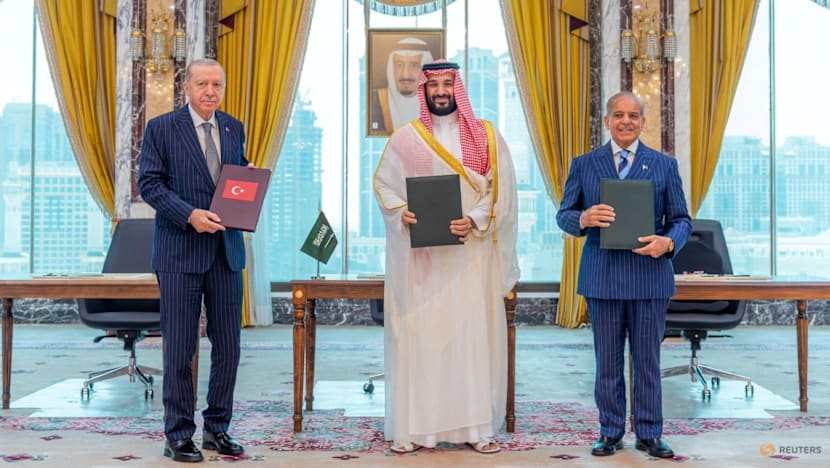
Analysts view the trilateral framework as potentially strengthening the countries' collective diplomatic and defense weight. Saudi Arabia, a major oil exporter and home to Islam's holiest sites, Pakistan, the only nuclear-armed Muslim country, and Türkiye, possessing NATO's second-largest military, represent significant geopolitical players. The signing occurred as Pakistani Prime Minister Shehbaz Sharif and Turkish President Tayyip Erdogan met with Saudi Crown Prince Mohammed bin Salman in Mecca.
If institutionalised and translated into concrete cooperation, the trilateral framework could strengthen the three countries' collective diplomatic and defense weight while contributing to the emergence of a more regionally driven security architecture.
DistantNews Editorial
Originally published by CNA in English. Translated, summarized, and contextualized by our editorial team with added local perspective. Read our editorial standards.
More Stories


From Our Blog

What Gets Lost (and Found) When News Is Translated

The Critical Role of Diaspora Media in Global News

What Travellers Should Know About Countries with Restricted Press

A Digital Nomad's Guide to Following Local News

How the Same Story Looks Different in Different Countries
