


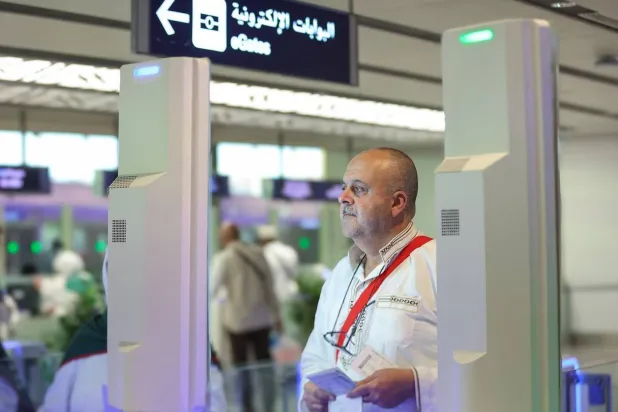
Saudi Passports Directorate Utilizes Airport E-Gates to Speed Up Hajj Pilgrim Departures
Summarized and contextualized by DistantNews.
At a glance
News
Named sources
Outcome reported
- Saudi Arabia's General Directorate of Passports is using e-gates at airports to speed up pilgrim departures after Hajj.
- These automated gates use biometric data to allow pilgrims to clear passport control in seconds.
- The initiative aims to improve passenger flow and reduce waiting times for travelers.
- Over 1.7 million pilgrims performed Hajj in 2026, with the majority arriving by air.
Saudi Arabia's General Directorate of Passports is leveraging advanced technology, including self-service e-gates at international airports, to expedite the departure process for pilgrims concluding their Hajj journey. This initiative is being implemented across all border crossings.
The automated e-gates instantly match biometric data, enabling departing pilgrims to complete passport control independently in a matter of seconds. This technological integration, spearheaded by the Ministry of Interior, significantly boosts passenger throughput, minimizes wait times, and ensures a more efficient exit for all travelers.
Saudi Arabia recently celebrated the exceptional success of this year's Hajj season, attributing it to an integrated system of security, organization, and services that facilitated the pilgrims' rituals with ease and tranquility. The 2026 Hajj saw a total of 1,707,301 pilgrims perform the rituals, with the vast majority, 1,485,729, arriving via air.
Major Nasser Al-Otaibi, spokesperson for the General Directorate of Passports, affirmed on Sunday that the directorate is actively executing its operational plan for pilgrim departures through all international air, land, and sea ports, ensuring a smooth conclusion to their spiritual journey.
The directorate continues to implement its operational plan for the departure of pilgrims through all international air, land, and sea ports.
DistantNews Editorial
Originally published by Asharq Al-Awsat. Summarized and contextualized by our editorial team with added local perspective. Read our editorial standards.
More Stories



From Our Blog

What Gets Lost (and Found) When News Is Translated

The Critical Role of Diaspora Media in Global News

What Travellers Should Know About Countries with Restricted Press

A Digital Nomad's Guide to Following Local News

How the Same Story Looks Different in Different Countries
