


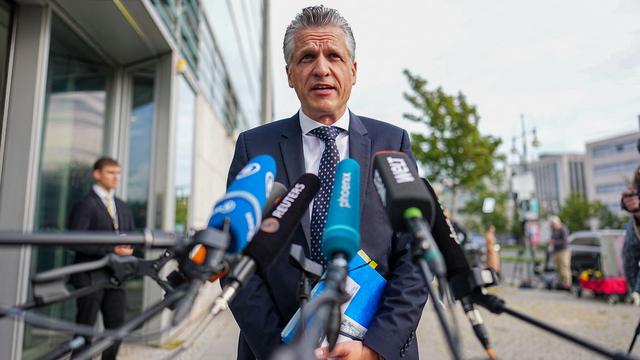

Schnieder after state election: “We must start with ourselves”
Translated from German and summarized by DistantNews. Read the original for the full story.
At a glance
Newswire
From a news agency
Context piece
- Gordon Schnieder urged Germany’s federal government to make clear decisions and end prolonged political disputes after the election in Saxony-Anhalt.
- He said the democratic centre must rebuild trust by addressing its own failures, after the AfD won 43.8% and the CDU fell to 17.2% in preliminary results.
- Schnieder cited the CDU-SPD coalition in Rhineland-Palatinate as an example of parties putting responsibility for the state above political positioning.
“We must start with ourselves,” Rhineland-Palatinate Premier and CDU leader Gordon Schnieder said after the election in Saxony-Anhalt. He called on the federal government to make clear decisions and stop arguing.
We must start with ourselves.
“Those who govern are responsible for ensuring that things work in the end, that problems are solved and decisions are made,” Schnieder said in Mainz. “Germany cannot afford endless political disputes.”
He said voters should not be expected to understand politics better. “We must deliver what people expect from politics: less arguing, clear decisions and concrete results.”
Those who govern are responsible for ensuring that things work in the end, that problems are solved and decisions are made.
The AfD more than doubled its share of the vote in Saxony-Anhalt to 43.8%, compared with 20.8% in 2021, according to preliminary results. The figure was the party’s strongest result in a state election and the highest achieved by any party in such elections over the past decade. The CDU fell to 17.2%, from 37.1%, its worst state-election result in Saxony-Anhalt.
We must deliver what people expect from politics: less arguing, clear decisions and concrete results.
“We must not simply return to business as usual after such a result,” Schnieder said. He pointed to the governing CDU-SPD coalition in Rhineland-Palatinate, saying the parties had not concealed their differences but had decided that responsibility for the state mattered more than party positioning. “We argue where necessary, but we reach agreement so the state can move forward,” he said, adding that he expected the same approach from the federal government.
We argue where necessary, but we reach agreement so the state can move forward.
About this summary
Originally published by Die Zeit in German. Translated, summarized, and contextualized automatically by DistantNews, with a note on how the source frames the story. Not individually reviewed before publishing. How this works.
More Stories
From Our Blog

News in Translation: What Gets Lost, and How We Keep the Framing

The Same Story, Different Countries: How Coverage Changes at the Border

Diaspora Media: How Communities Follow News From Home

Traveling Where the Press Is Not Free: How to Read the News There

The Digital Nomad's Guide to Local News
