


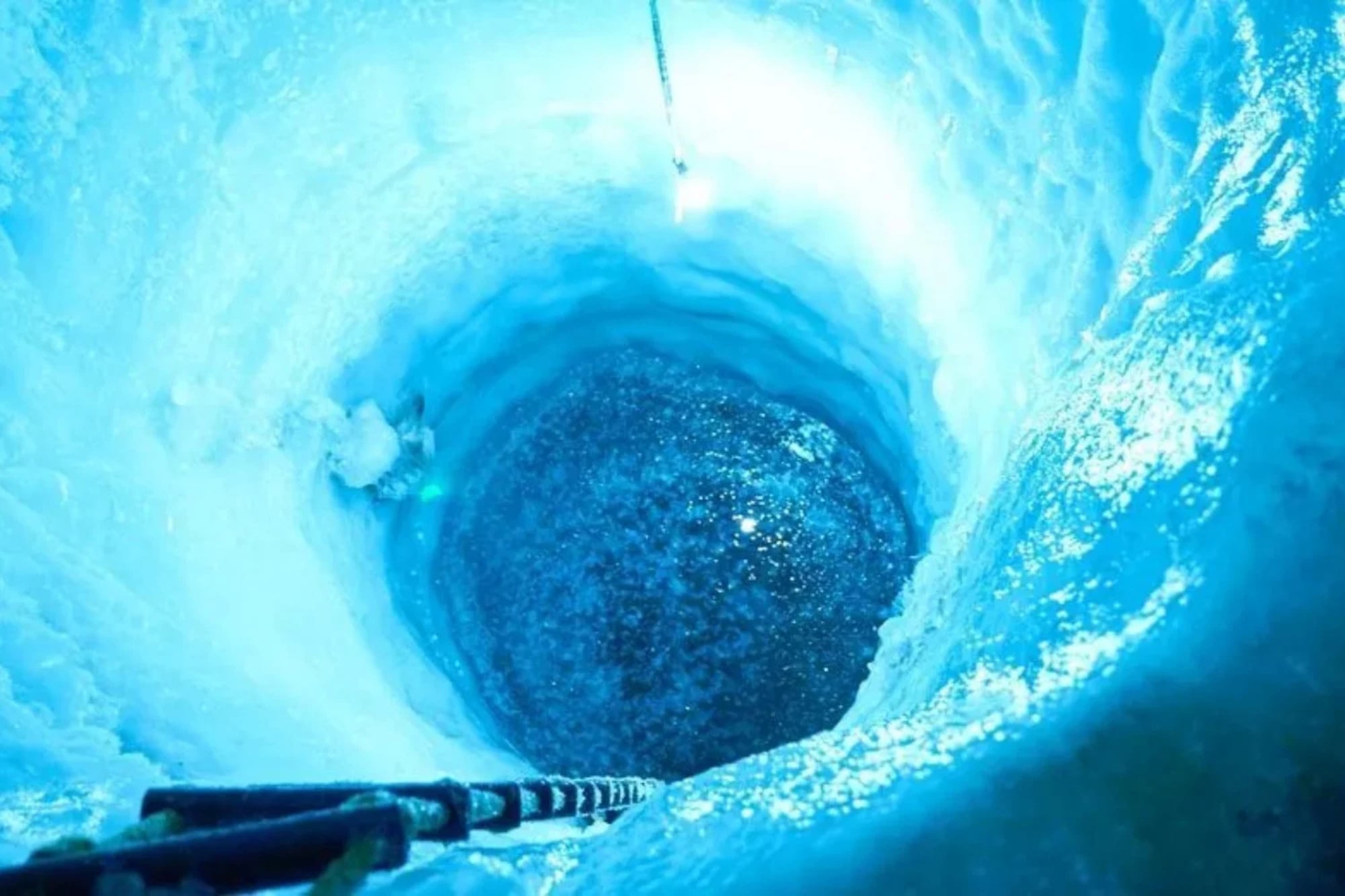
Scientists Discover Ancient Fan-Shaped Structure Beneath Antarctic Ice
Translated from Spanish, summarized and contextualized by DistantNews.
At a glance
News
Documents & data
Context piece
- Scientists drilling through Antarctic ice have discovered a fan-shaped subglacial structure at a depth of 3,000 meters.
- Dubbed the East Antarctic Fan-Shaped Basin Province (EAFBP), the structure consists of 30 subglacial basins radiating from a focal point near the South Pole.
- Researchers believe the EAFBP formed before the breakup of the supercontinent Gondwana and influences the flow of ice streams and the subglacial landscape.
A team of scientists has made a significant discovery beneath the Antarctic ice, uncovering a previously unknown fan-shaped structure buried 3,000 meters below the surface. This finding, published in the journal Nature Geoscience, reveals a subcontinental landscape that predates the separation of the Gondwana supercontinent.
The structure, named the East Antarctic Fan-Shaped Basin Province (EAFBP), is described as a system of enormous subglacial basins that collectively form a continental architecture not previously recognized as a coherent unit. Researchers identified this feature by analyzing subglacial topography and geophysical data, observing 30 V-shaped subglacial basins radiating from a focal point near the South Pole. The overall shape resembles an open hand fan, spanning a vast region from Prydz Bay to the Transantarctic Mountains.
Scientists propose that this unique landscape resulted from distributed intraplate rotational extension that occurred before Gondwana fragmented. This process had several major consequences on a continental scale. To the west, it generated compressional forces that led to the uplift of the Gamburtsev Mountains, explaining their youthful topography. To the east, it caused a clockwise rotation of the northern segment of the Transantarctic Mountains, splitting them into three tectonic blocks and driving their differential uplift.
To the north, the fan's edge created a lithospheric weakness line that controlled the separation between Antarctica and Australia, shaping the semicircular passive continental margins observed today. The EAFBP is not merely a geological record; it actively influences the present-day Antarctic ice sheet. It plays a role in controlling the flow of ice streams and shaping the subglacial landscape. Furthermore, the faults and basin boundaries within the EAFBP have guided the development of deep valleys and the location of major outlet glaciers.
DistantNews Editorial
Originally published by La Nación in Spanish. Translated, summarized, and contextualized by our editorial team with added local perspective. Read our editorial standards.
More Stories



From Our Blog

What Gets Lost (and Found) When News Is Translated

The Critical Role of Diaspora Media in Global News

What Travellers Should Know About Countries with Restricted Press

A Digital Nomad's Guide to Following Local News

How the Same Story Looks Different in Different Countries
