


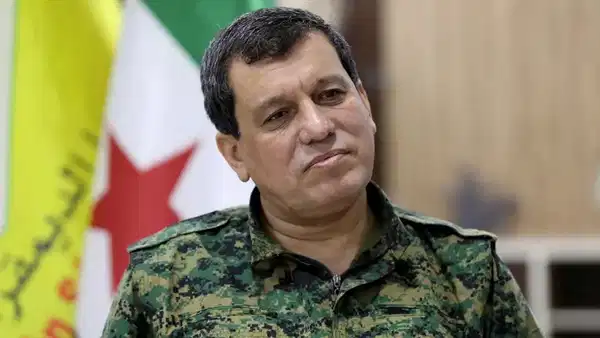
SDF leader Mazlum Abdi reportedly preparing to launch new political movement in Syria
Translated from Turkish, summarized and contextualized by DistantNews.
At a glance
News
Named sources
Context piece
- Mazlum Abdi, a leader of the Syrian Democratic Forces (SDF), is reportedly preparing to launch a new political project in Syria.
- The new entity aims to be inclusive of various ethnic and religious groups and will reportedly abolish the co-chair system.
- The project, expected by late 2026, has reportedly received approval from the Syrian government and may not face opposition from Turkey under certain conditions.
Mazlum Abdi, a prominent figure in Syria's Kurdish-led administration, is reportedly poised to establish a new political movement, according to sources close to him speaking to Al Arabiya. This initiative follows the full integration of the Syrian Democratic Forces (SDF) into the Syrian state, a process initiated by an agreement between Abdi and Syrian government representatives in March 2025.
The new entity is planned not to carry any ethnic or nationalist identity and to bring together Syrian names from different ethnic and religious communities.
The planned political project is designed to be non-ethnic and non-nationalist, aiming to unite Syrians from diverse ethnic and religious backgrounds. Sources suggest the new entity will be announced before the end of 2026. A significant shift within the SDF's administrative structure is also anticipated, with the reported abolition of the 'co-chair' system, where leadership roles were shared by a man and a woman.
The co-chairmanship system used by the SDF, where administrative, civil, and military duties are jointly carried out by a woman and a man, will be abolished.
Reports indicate that the Syrian government has approved the new political formation, with plans for a center to be opened in Damascus. However, the absence of a political parties law in Syria could pose a challenge. Turkey reportedly has no objection to the new movement, provided it does not include non-Syrian nationals, particularly Turkish Kurds previously associated with the PKK.
The new political formation has the approval of the Syrian government.
Abdi, who joined the PKK in the 1990s and led its Syrian branch for over a decade, has reportedly lost many of his international and regional connections due to recent political shifts in Syria. Despite offers from the Syrian government to work with its presidential team in Damascus, Abdi is said to be unwilling to take on any government role for now. The report also notes that while a close associate of Abdi, Samir Oso (known as 'Sipan Hemo'), has been removed from Turkey's terror list, Abdi's name remains on it.
Turkey's fundamental condition is that individuals who are not Syrian citizens, especially Turkish Kurds who were previously in the PKK ranks, are not included in the structure.
DistantNews Editorial
Originally published by Cumhuriyet in Turkish. Translated, summarized, and contextualized by our editorial team with added local perspective. Read our editorial standards.
More Stories

From Our Blog

What Gets Lost (and Found) When News Is Translated

The Critical Role of Diaspora Media in Global News

What Travellers Should Know About Countries with Restricted Press

A Digital Nomad's Guide to Following Local News

How the Same Story Looks Different in Different Countries
