


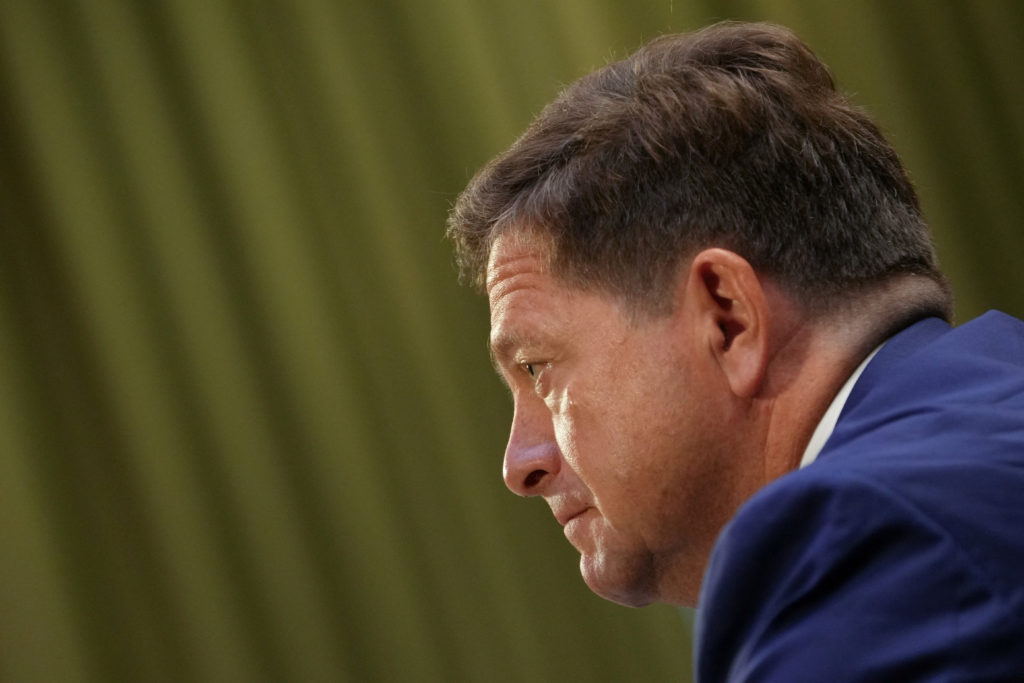
Senate panel advances Jay Clayton's nomination for director of national intelligence
Summarized and contextualized by DistantNews.
At a glance
News
Named sources
Ongoing story
- The Senate Intelligence Committee advanced Jay Clayton's nomination for director of national intelligence on a party-line vote of 9-8.
- The committee's approval followed Clayton's refusal during a hearing to state whether former President Joe Biden won the 2020 election.
- Republicans aim for a swift confirmation, while Democrats expressed disappointment, seeking a leader who acts as a restraint rather than an agitator.
The Senate Intelligence Committee has advanced Jay Clayton's nomination to lead the nation's intelligence agencies, with the vote splitting along party lines, 9-8. This decision comes after a contentious hearing where Clayton, President Donald Trump's pick, repeatedly declined to explicitly state that Joe Biden won the 2020 election.
bitterly disappointed
Despite some initial praise from Democrats, their support shifted following Clayton's performance at the hearing. Sen. Mark Warner, the top Democrat on the committee, expressed "bitter disappointment," noting his past work with Clayton but criticizing his stance on the election results. The committee's approval now sends the nomination to the full Senate for a floor vote, which could occur as early as next week.
Clayton's nomination is part of Trump's broader effort to revisit the 2020 election, which he lost. While Clayton told senators he had no involvement in Trump's recent speech questioning the election, he consistently stated the election was "certified" for Biden without directly confirming Biden's victory. Warner indicated a desire for a director who would act as a "restraint, not an agitator."
We are between a rock and a hard place
Republicans are eager to confirm Clayton, especially given concerns about the interim director, Bill Pulte, who has no known intelligence experience and previously investigated perceived political enemies. Republicans hoped for Clayton's confirmation in June to avoid Pulte's interim role, but Trump delayed the nomination. The path forward in the Senate remains uncertain, with Democrats debating whether to allow a swift vote, though Warner suggested he does not wish to slow the process given the alternative.
I saw firsthand how a strong national security apparatus depends on decisive judgment, discipline, integrity, and effective communication and cooperation across different branches of the government.
DistantNews Editorial
Originally published by PBS NewsHour. Summarized and contextualized by our editorial team with added local perspective. Read our editorial standards.
More Stories


From Our Blog

How the Same Story Looks Different in Different Countries

What Gets Lost (and Found) When News Is Translated

The Critical Role of Diaspora Media in Global News

What Travellers Should Know About Countries with Restricted Press

A Digital Nomad's Guide to Following Local News
